Your residence status depends on two key factors: the number of days you spend in the UK and your connections, or ‘ties’, to the country.
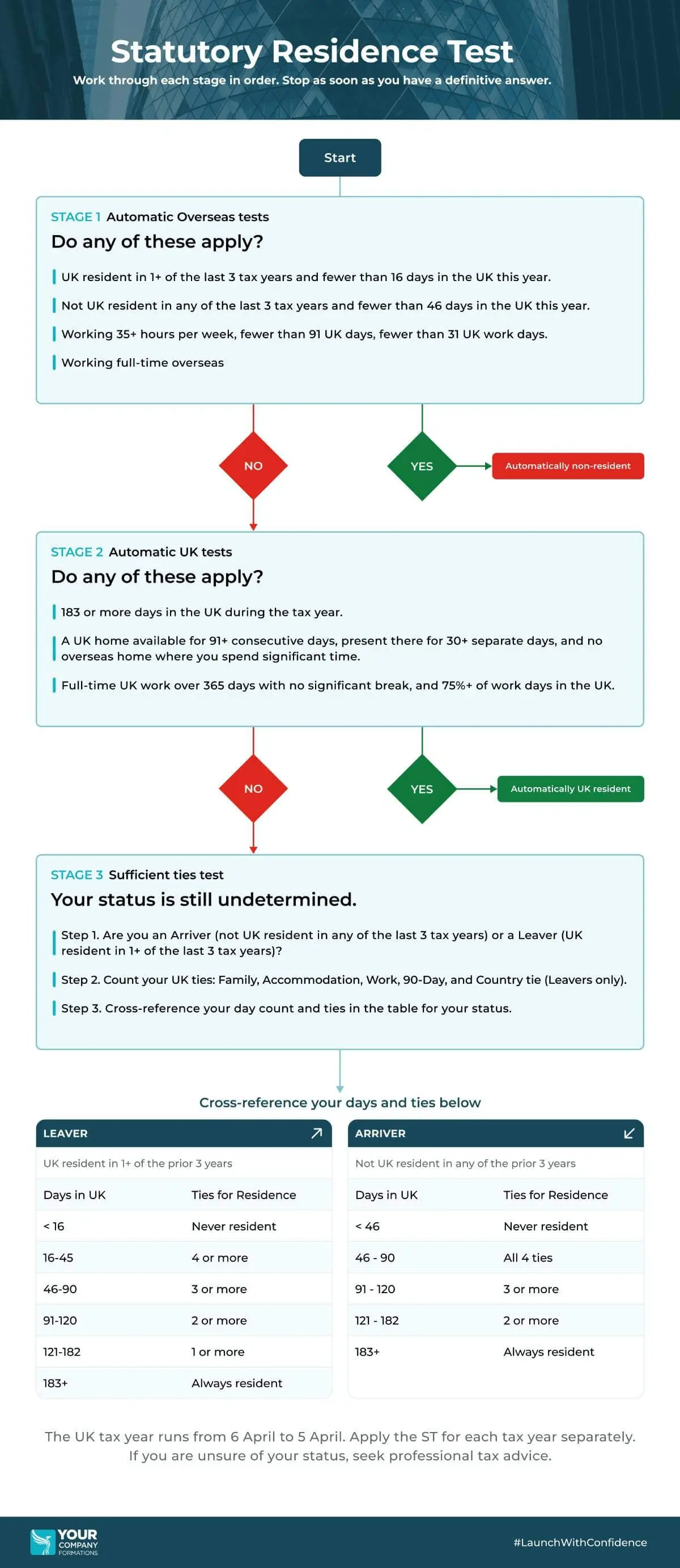
Apply the test’s three parts sequentially, stopping as soon as you get a definitive answer. First, the Automatic Overseas Tests confirm non-residence. If your status is not confirmed, the Automatic UK Tests check for automatic residency. Finally, the Sufficient Ties Test combines your days in the UK with your connections to the country for a final decision.
Calculate Your UK Day Count Using 4 Key Rules
Your UK day count is the single most important number in the Statutory Residence Test, and four rules determine the final total.
Rule 1: Count Any Day You Are Present in the UK at Midnight
A ‘day in the UK’ is any day on which you are present in the UK at midnight. If you arrive at 9 am and depart at 11 pm on the same day, your UK day count for that day is zero. The midnight presence rule allows day trips for meetings without counting toward your total days spent in the UK.
Rule 2: Exclude Days Spent Transiting Through the UK
You do not count days spent transiting through the UK from one country to another, outside the UK. The transit exemption applies if you arrive as a passenger, depart the next day, and do not engage in activities unrelated to your transit, like business meetings or social visits.
Rule 3: Add ‘Deemed Days’ for Leavers with 3+ UK Ties
The ‘deemed days’ anti-avoidance rule applies only to leavers. If you have at least three UK ties and make more than 30-day trips to the UK where you are not present at midnight, HMRC deems every subsequent day trip a full UK day and adds it to your midnight count. Adding deemed days to your total can unexpectedly push you into a higher tax bracket.
Rule 4: Disregard up to 60 Days for Exceptional Circumstances
You can disregard up to 60 days spent in the UK due to exceptional circumstances, such as a sudden illness or civil unrest, from your day count. HMRC defines ‘exceptional circumstances’ narrowly, typically limiting it to events beyond your control. Exceptional-circumstance days still count toward work and country ties.
Stage 1: Use Automatic Overseas Tests to Confirm Non-Residence
Meeting any of the Automatic Overseas Tests confirms you are a non-resident in the UK in the tax year, and you do not need to proceed to Stage 2.
Test 1: Spend Fewer Than 16 Days in the UK (For Recent Residents)
You are automatically non-resident if you were a UK resident in one or more of the previous three tax years and you spend fewer than 16 days in the UK in the current tax year.
Test 2: Spend Fewer Than 46 Days in the UK (For Newcomers)
You are automatically non-resident if you were not a UK resident in any of the three previous tax years and you spend fewer than 46 days in the UK.
Test 3: Work Full-Time Overseas with Limited UK Presence
You are automatically a non-resident if you work full-time abroad. To qualify, you must average 35+ hours per week overseas, spend fewer than 91 days in the UK, have fewer than 31 UK work days (where you work for more than 3 hours), and take no ‘significant break’ from your overseas work.
Stage 2: Check Automatic UK Tests to Confirm Residence
If you do not meet any Automatic Overseas Tests, you must check the Automatic UK Tests. Meeting just one makes you automatically a UK resident for the tax year.
Test 1: Spend 183 or More Days in the UK
You are automatically a UK resident if you spend 183 days or more in the UK during the tax year. The 183-day threshold is absolute.
Test 2: Have a UK Home with No Overseas Home
You are automatically a UK resident if you have a home in the UK available for at least 91 consecutive days, you are present in that home for at least 30 separate days, and you have no overseas home where you spend significant time.
Test 3: Work Full-Time in the UK
You are automatically a UK resident if you work full-time in the UK. For tax purposes, working full-time in the UK means you work for 365 days without a significant break and over 75% of your workdays (days with 3+ hours of work) are in the UK.
Stage 3: Use the Sufficient Ties Test as a Final Tie-Breaker
If your residence status is still undetermined, you must use the Sufficient Ties Test. The test combines the number of days you spend in the UK with the number of connections, or ‘ties’, you have to the UK.
Step 1: Establish Your Status as an ‘Arriver’ or ‘Leaver’
Your status as an ‘arriver’ or ‘leaver’ is critical because it determines which tie-breaker table you use and how many ties you are assessed against.
- Arriver: You were not a UK resident in any of the three preceding tax years.
- Leaver: You were a UK resident in one or more of the three preceding tax years. Leavers face much stricter day-count thresholds.
Step 2: Count Your UK Connections Across 5 Categories
The Sufficient Ties Test measures your connections to the UK across five categories. Arrivers are assessed on four ties; leavers on all five.
The Family Tie
You have a family tie if your spouse, civil partner, a partner you live with as if married, or your minor child (under 18) is a UK resident. An important exception exists: you do not have a family tie through your child if you spend fewer than 61 days in the UK with them during the tax year. Children in full-time UK education are not considered UK residents for this tie if they spend fewer than 21 days in the UK outside of term time.
The Accommodation Tie
You have an accommodation tie if you have a place to live in the UK that is available for a continuous period of 91 days or more, and you spend at least one night there. The accommodation tie applies to property you own or rent, or to a room at a close relative’s house. If the accommodation is for a close relative (such as a parent or sibling), the threshold increases from one night to 16 nights.
The Work Tie
You have a work tie if you work for more than 3 hours in the UK on 40 or more days in the tax year. The 40 work days do not need to be consecutive. Director duties, attending board meetings, signing documents, and even answering emails count as work. A day contributes to this tie even if you leave the UK before midnight.
The 90-Day Tie
You have a 90-day tie if you spent more than 90 days in the UK in either of the two previous tax years. UK tax law requires that you assess your residence status for each tax year separately. A period of heavy UK presence can limit your flexibility for the next two years.
The Country Tie (Leavers Only)
You have a country tie if the UK is the country where you were present at midnight on the greatest number of days in the tax year. The country tie only affects leavers and catches those who split their time across multiple countries without a clear primary base outside the UK.
Step 3: Cross-Reference Days and Ties to Determine Your UK Tax Residency
Cross-reference your status (arriver or leaver), your UK day count, and your number of ties to find your residence status for the tax year.
| Days Spent in the UK | Ties Needed for UK Residence |
|---|---|
| 16–45 | 4 or more ties |
| 46–90 | 3 or more ties |
| 91–120 | 2 or more ties |
| 121–182 | 1 or more tie |
| Days Spent in the UK | Ties Needed for UK Residence |
|---|---|
| 46–90 | All 4 ties |
| 91–120 | 3 or more ties |
| 121–182 | 2 or more ties |
How to Manage a UK Directorship Without Becoming a Tax Resident
Owning shares in a UK company creates no ties to the UK. Directorship, however, directly creates risk.
How Directorship Creates UK Resident Tax Risk
A work tie, combined with an accommodation tie, can make you a UK resident after spending as few as 91 days in the UK.
Use these strategies to mitigate your work tie risk:
- Attend board meetings virtually from outside the UK.
- Keep any essential UK meetings under three hours to avoid triggering a ‘work day’.
- Limit UK work days to fewer than 40 per tax year.
- Appoint UK-resident directors to handle day-to-day operational matters.
Company Residence vs. Personal Residence
Incorporating a company in the UK automatically makes it a UK tax resident. The SRT determines your personal tax residence separately. The risk for non-UK incorporated companies is that if the board exercises central management and control (i.e., board-level decisions) from within the UK, the company itself may become UK tax-resident.
Which Director Scenario Defines Your UK Tax Risk?
Scenario 1: Quarterly Board Meetings, No Other UK Ties
An arriver flies in for four two-day board meetings a year (8-12 days). With zero or one tie, they can spend up to 182 days in the UK without becoming resident. Risk: Very Low.
Scenario 2: Monthly UK Visits with a London Flat
An arriver who visits monthly (24-36 days) and keeps a flat in London establishes an accommodation tie. A 90-day tie from previous years would give this director two ties, setting their day limit to 120. If the visits also create a work tie, the director has three ties, and their limit drops to 90 days. Risk: Moderate.
Scenario 3: Family Relocated to London
An arriver whose spouse and children move to London establishes a family tie. The arriver’s London home creates an accommodation tie, business visits create a work tie, and past travel creates a 90-day tie. With all four ties, the arriver becomes a UK resident after spending just 46 days in the UK. Risk: Very High.
Scenario 4: Fully Remote Directorship
A director manages their UK company entirely from abroad, with no travel to the UK. They spend zero days in the UK and meet the Automatic Overseas Test. Risk: Negligible.
Scenario 5: The Recent Leaver with Lingering Ties
A former UK resident leaves but keeps their UK home; their spouse remains temporarily and visits monthly for board meetings. As a leaver, they likely have five ties (family, accommodation, work, 90-day, country). They become UK resident after spending only 16 days in the UK. Risk: Extreme.
Use Split Year and Non-Residence Rules to Limit Tax Exposure
Apply Split Year Treatment to Tax Only Part of a Year
If you move to or from the UK partway through a tax year, split-year treatment can apply. The split-year rule divides the tax year into a UK part and an overseas part. In the UK, HMRC taxes your worldwide income; overseas, HMRC taxes only your UK-source income.
Split-year treatment is not optional. The rule applies automatically if you meet one of the eight specific ‘Cases’ detailed in HMRC’s Residence, and FIG Regime Manual, such as starting full-time work overseas or your partner starting full-time work in the UK. A year where you claim split-year treatment still counts as a year of UK residence for determining your ‘leaver’ or ‘arriver’ status in future years.
Avoid the 5-Year Clawback on Capital Gains and Dividends
The temporary non-residence rules prevent former residents from leaving the UK for a short period to realise gains or income tax-free. If you were a UK resident in at least four of the seven tax years before your departure from the UK, and you return within five years, HMRC taxes certain income and gains you realise during your non-resident period in your year of return.
HMRC’s clawback rule specifically applies to capital gains tax from the sale of company shares and to dividends from closed companies. To escape these rules, you must remain non-resident for more than five complete tax years.
Understand How April 2025 Tax Changes Increase Your Global Tax Risk
The SRT rules have not changed, but the consequences of UK residence have.
- Prepare for the End of the Non-Dom Regime
The UK’s non-domiciled tax regime ended on , a change that removes the ‘remittance basis’ which allowed long-term UK residents to shield foreign income and gains from UK tax. - Adapt to the New 4-Year Foreign Income and Gains (FIG) Regime
New arrivals who have been non-resident for the previous 10 years can benefit from a new four-year regime. During this period, they will not pay UK tax on foreign income and gains. After four years of UK residence, they will be subject to UK tax on their worldwide income. - Factor in New Residence-Based Inheritance Tax Rules
The residence-based test will replace the concept of domicile for inheritance tax (IHT). Worldwide assets will fall within the scope of UK IHT after 10 years of UK residence.
Accidentally becoming a UK resident now has immediate and significant worldwide tax implications.
The Statutory Residence Test Flowchart

Your email address will not be published. Required fields are marked *