

Rachel Reeves presented the first Budget from a Labour government in 14 years to Parliament on 30 October 2024. Autumn Budget 2024 set out measures intended to support long-term UK economic growth, including investment in transport, housing, R&D and capital funding. It also announced measures covering sustainable development, tax compliance, support for working people and public spending.
The Office for Budget Responsibility’s October 2024 forecast estimated that the Budget’s additional spending would provide a temporary boost to demand and raise GDP in the near term. It projected that this effect would fade during the five-year forecast and leave the level of GDP broadly unchanged by 2029/30.
What Corporation Tax Measures Did Autumn Budget 2024 Announce?
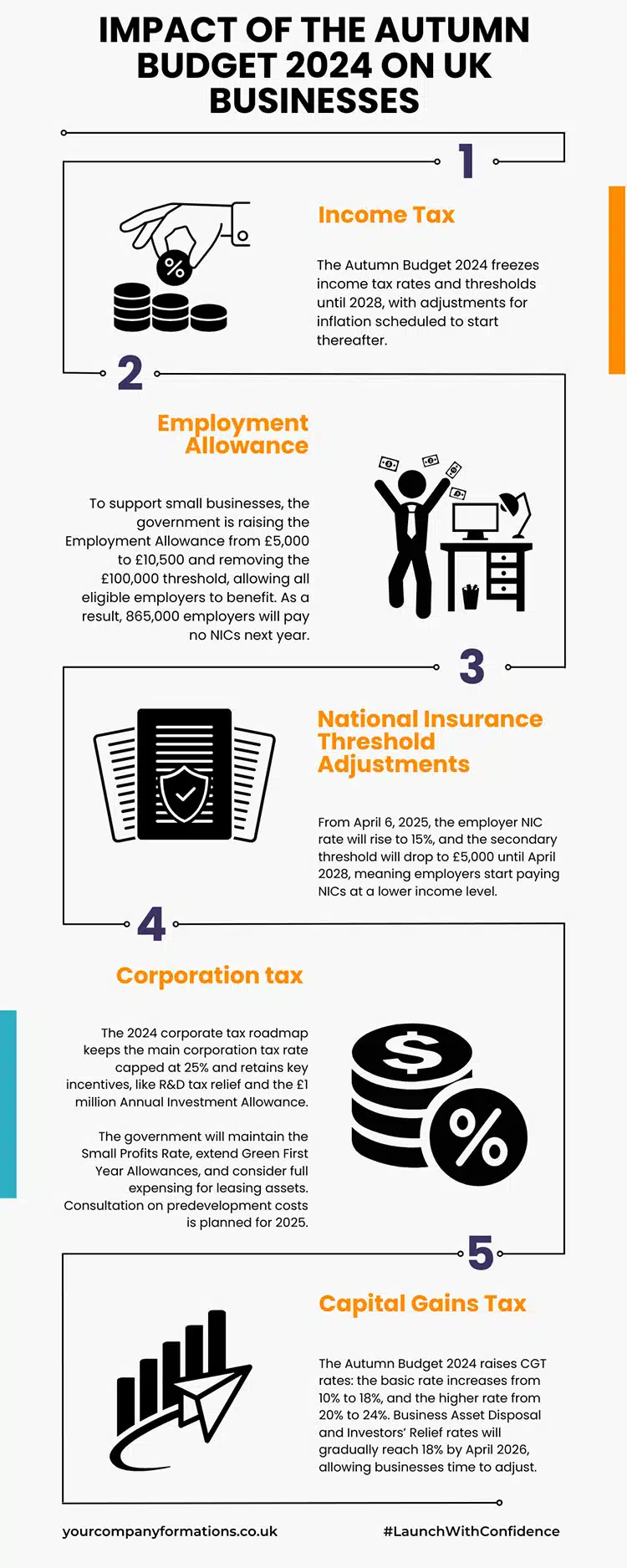
The Corporate Tax Roadmap published alongside Autumn Budget 2024 committed the government to capping the Corporation Tax main rate at 25% for the duration of the Parliament while maintaining R&D tax reliefs and key capital allowances.
Key Points on Corporation Tax Rates and Allowances:
- The roadmap committed the government to retaining the Corporation Tax Small Profits Rate and marginal relief at their existing rates and thresholds. At the time, the government stated that this would mean 9 in 10 actively trading companies, including a majority of SMEs, would pay Corporation Tax at a rate below 25%.
- The £1 million Annual Investment Allowance (AIA), which allows businesses to deduct the cost of qualifying expenditure on plant and machinery from taxable profits, remains in place.
Updates to Capital Allowances:
- Green First Year Allowances: The 100% first-year allowances for zero-emission cars and electric vehicle charge points are available until 31 March 2027 for Corporation Tax purposes and 5 April 2027 for Income Tax purposes.
- Full Expensing and leased assets: Assets bought for leasing or hiring generally remain excluded from full expensing. However, a new 40% First Year Allowance applies to qualifying main-rate plant and machinery bought from 1 January 2026, including most assets acquired for leasing.
- Enhanced Clarity on Capital Allowances: The 2024 roadmap committed HMRC to working with businesses and other stakeholders to simplify the tax system and improve the user experience.
- Consultation on Predevelopment Costs: The government opened a consultation on the tax treatment of predevelopment costs on 13 July 2026. It is seeking evidence on uncertainty in the current tax treatment and its effect on commercial investment decisions.
Full expensing generally remains limited to qualifying assets purchased and owned by the company. Assets bought for leasing or hiring normally remain excluded from full expensing, although most qualifying leased assets bought from 1 January 2026 may qualify for the 40% First Year Allowance.
Measures to tackle tax avoidance:
- Autumn Budget 2024 announced increased collaboration between HMRC, Companies House and the Insolvency Service to tackle directors using contrived corporate insolvencies and dissolutions, often called “phoenixism”, to evade tax.
- HMRC began rolling out mandatory registration for paid tax advisers who interact with HMRC on behalf of clients from 18 May 2026. Registration windows are being introduced in stages, and advisers must meet HMRC’s registration conditions.
- Changes to tax rules on Limited Liability Partnership liquidations: From 30 October 2024, the Capital Gains Tax treatment changed where an LLP is liquidated, and assets are transferred to a contributing member or a connected person. The measure closed a route used to avoid tax.
- HMRC introduced a strengthened reward scheme for informants in November 2025. Where information leads to the recovery of more than £1.5 million in tax, rewards can be up to 30% of the additional tax collected, excluding penalties and interest.
- Close company shareholder anti-avoidance rules: From 30 October 2024, changes to the loans-to-participators rules removed opportunities for shareholders to sidestep the anti-avoidance provisions and extract funds untaxed.
- From 6 April 2025, HMRC’s late payment interest rates increased by 1.5 percentage points.
The planned consultations have progressed. HMRC launched the Advance Tax Certainty Service for major investment projects in July 2026, while the transfer pricing and permanent establishment consultation concluded in 2025, with the resulting reforms generally applying to chargeable periods beginning on or after 1 January 2026. A separate consultation on predevelopment costs opened on 13 July 2026 and closes on 21 September 2026.
What Changes Have Been Made to Employment Allowance?
Autumn Budget 2024 increased the Employment Allowance from £5,000 to £10,500 from 6 April 2025 and removed the previous £100,000 employer NIC liability limit. At the time, the government estimated that 865,000 employers would pay no employer NICs in 2025/26 as a result.
Find out more: Work From Home Tax Relief Clarified
What Creative Industry Tax Reliefs Took Effect in 2025?
Changes that took effect from April 2025 increased the credits and relief rates available to qualifying film, TV, theatre, orchestra and museum productions. The measures include:
- Audio-Visual Expenditure Credit: Since 1 April 2025, qualifying UK visual effects costs for film and high-end TV productions have had a 39% credit rate and have been exempt from the 80% cap. Qualifying costs incurred from 1 January 2025 are eligible.
- Independent Film Tax Credit: From 1 April 2025, qualifying films can claim Audio-Visual Expenditure Credit at 53% on up to £15 million of core expenditure. Under the current eligibility rules, a film must have core expenditure of £23.5 million or less, begin principal photography on or after 1 April 2024, and either be an official co-production or have a UK lead writer or director. The higher rate applies to qualifying expenditure incurred from 1 April 2024.
- Theatre, Orchestra, and Museums & Galleries Tax Relief: From 1 April 2025, the rates are 40% for qualifying non-touring productions and exhibitions, and 45% for qualifying touring productions, touring exhibitions and orchestra productions.
How Should Businesses Prepare for the UK Carbon Border Adjustment Mechanism (CBAM)?
To prepare for the UK’s new Carbon Border Adjustment Mechanism (CBAM) launching on January 1, 2027, businesses in affected sectors like aluminium, cement, fertiliser, hydrogen, and iron and steel should consider these key steps:
- Assess supply chains and emissions: Understand carbon emissions across your supply chains, especially for goods imported into the UK. Consider strategies to reduce emissions or shift to suppliers with lower carbon footprints to minimise the impact of the new carbon pricing on imports.
- Compliance planning: Check whether the total value of specified CBAM goods you import meets or exceeds the £50,000 registration threshold under either test: expected imports over the next 30 days or imports during the previous 12 months. Businesses below the threshold should still keep records and monitor import values.
- Evaluate cost implications: The added carbon price could increase operational costs for businesses reliant on imported goods from affected sectors. Review your pricing strategies and consider possible adjustments to accommodate these new expenses.
- Prepare financially for compliance and reporting: Put systems in place to record the value and embodied emissions of imported CBAM goods. The UK CBAM is intended to reduce carbon leakage by ensuring affected imports face a carbon price comparable to UK production.
By proactively assessing emissions, compliance requirements, and potential cost impacts, businesses can position themselves well ahead of the 2027 launch.
How do the Income Tax and National Insurance Threshold Adjustments Affect Employers?
From 6 April 2025, the employer NIC rate increased from 13.8% to 15%, and the Secondary Threshold fell to £5,000 a year. This means employers begin paying NICs at a lower income level per employee.
Where do these Employer NIC Changes Stand for 2026?
These measures are now in force and carry unchanged into the 2026/27 tax year, so the figures above are settled for payroll planning. The combined effect is worth checking: the lower £5,000 secondary threshold pulls more pay into charge, but the raised £10,500 Employment Allowance still cancels the employer NIC bill for many small firms. Confirm your eligibility on GOV.UK before assuming the allowance clears it, as connected-company and single-director rules can exclude you.
What Income Tax Changes Did Autumn Budget 2024 Announce?
The Autumn Budget 2024 initially kept the Personal Allowance and the main Income Tax thresholds for England, Wales and Northern Ireland frozen until April 2028. Budget 2025 extended the freeze to 5 April 2031. The Personal Allowance remains £12,570 across the UK, while the higher-rate threshold remains £50,270 in England, Wales and Northern Ireland.
Find out more: Tax Brackets UK: Income Tax Rates and Allowances
How Did Autumn Budget 2024 Change Capital Gains Tax?
The Autumn Budget 2024 increased the main CGT rates from 10% and 20% to 18% and 24% for disposals made on or after 30 October 2024. The rates for Business Asset Disposal Relief and Investors’ Relief rose to 14% from 6 April 2025 and are now 18% for qualifying disposals made on or after 6 April 2026.
How Should Businesses Prepare for the Tax and Policy Changes After the Autumn Budget Statement?
Businesses should review the measures announced in the Autumn Budget 2024 alongside the later policy changes covered above. Making appropriate use of reliefs and allowances that remain available in 2026 can help improve cash flow, reduce costs and support growth.
For instance, a business can:
- Maximise employment allowances: Businesses can maximise increased NIC savings by reinvesting in human resources. Consider expanding your team, extending current employees’ hours, or investing in staff training to drive productivity. These allowances can help reduce wage-related expenses and support workforce growth.
- Utilise specific sectoral tax reliefs: Businesses in film, high-end TV production and cultural industries can use enhanced Audio-Visual Expenditure Credit and tax reliefs for theatre, orchestra and museum productions. Review the current eligibility rules and qualifying costs before planning projects, including the higher credit rates and treatment of UK visual effects expenditure.
- Strategise for energy and environmental credits: If your business is involved in renewable energy or eco-friendly initiatives, explore the updated credits and grants aimed at energy transition and sustainability. These initiatives could lower operational costs and reduce tax burden, aligning with long-term environmental goals while benefiting from government support.
- Prepare for tax compliance measures: With several compliance and anti-avoidance measures announced since the Autumn Budget 2024 now in force or moving through implementation, businesses should review their practices against current HMRC guidance. Strengthen internal tax reporting, record-keeping and compliance policies, and consider consulting a tax adviser where necessary.
- Check current policy and consultation updates: Several consultations announced in Autumn Budget 2024 have now concluded or moved into implementation, while others remain open. Review current GOV.UK guidance before responding to a consultation or changing business plans.
By taking these steps, businesses can use the Budget measures that remain available, respond to later policy changes and prepare for future requirements.
Impact of Autumn Budget 2024 on Business
Frequently Asked Questions About Autumn Budget 2024
What Inheritance Tax Changes from Autumn Budget 2024 Apply Now?
Agricultural Property Relief and Business Property Relief reforms took effect on 6 April 2026. Individuals receive 100% relief on the first £2.5 million of combined qualifying property and 50% above it. Most unused pension funds and death benefits enter estates for Inheritance Tax from 6 April 2027.
Is the 5p Fuel Duty Cut Still in Place?
Yes. The temporary 5p-per-litre fuel duty cut remains in place until 31 December 2026. The government has said it will confirm the fuel duty rates applying from January 2027 at Budget 2026.
What is the Current Tax Position for Private School Fees?
Private school fees have been subject to 20% VAT since 1 January 2025. Since 1 April 2025, charitable schools generally lost business rates relief. Local authorities can reclaim VAT on funded places, while qualifying English schools mainly educating pupils with Education, Health and Care Plans retain relief.

This was an insightful read. Thanks for highlighting the impact of Autumn budget 2024 on businesses.