
What is the working from home tax relief?
As you work from home, you may notice an increase in expenses such as electricity, internet usage, furniture, and home office equipment due to extra use. Whether you are a contractor, freelancer, or small business owner, many of these expenses can be claimed as deductions to reduce your income tax bill, making the work-from-home experience more manageable and lower your overall tax liability.
What is the working from home allowance?
The work-from-home allowance is a payment some employers offer to help employees cover additional costs incurred while working from home, such as electricity, heating, or internet. If the allowance provided by the employer only partially covers these expenses, employees may be eligible to claim the difference with HMRC. However, employees cannot make a claim if the employer fully reimburses their costs.
Who can and cannot claim tax relief?
Not everybody is eligible for this tax relief. You cannot claim the tax rebate if your work-from-home arrangement is based on convenience for you or your employer. For example, you are not eligible if:
- Your employment contract allows you to choose to work from home or the office.
- You work from home because your employer’s office is full or unavailable.
For you to qualify for any amount of tax relief, working from home must be a requirement of your role, not a personal or optional arrangement.
Who is now eligible for working from home tax relief?
You may be able to claim tax relief for your job expenses if you:
- Are required to work from home because your job does not have an office, or
- Live so far from your job location that daily travel is unreasonable.
To qualify, the expenses you claim must be essential and used exclusively for your work.
What home office expenses can I claim work from home?
You can only claim work from home expenses that are necessary and used wholly and exclusively for work. For example, you may claim the portion of your electricity bill that applies to your work area, but you cannot claim expenses that are both for work and personal use. You can also claim for items or services you paid for out of your own money, provided they meet the eligibility criteria.
You can claim tax relief for additional household costs on things like:
- Additional metered water, heating or lighting costs: You may claim the extra costs incurred, calculated by comparing usage before and after working from home.
- Internet costs: Only claimable if you:
- Did not have the internet before working from home.
- Or can show an increase in usage due to work needs.
- Cleaning costs: If specifically related to your work area.
- Business calls: Calls made exclusively for work purposes.
- Office supplies: Items like stationery or printer ink used solely for work.
- Home office furniture and equipment: If you purchase furniture or equipment for home working, it must either be returned to your employer when you leave the company, or you may be required to pay tax on it as a benefit-in-kind. HMRC is unlikely to accept claims for home office furniture and equipment
You cannot claim tax relief if your employer reimburses all the expenses you incurred or if you purchased work-related items as an elective alternative to what your employer provided. For instance, if your employer gave you a laptop but you chose to buy a better model instead, you would not be eligible to claim for that expense. However, if your employer only partially reimbursed you, you can claim tax relief for the unpaid amount.
How do you claim tax relief for working from home?
To claim tax relief for working from home, follow these steps:
- Provide evidence: You must show that you work from home. If you claim the exact amount spent, submit copies of receipts and bills for eligible expenses.
- Claim through self-assessment: If you complete a self-assessment tax return, include your claim.
- Use HMRC’s online service: If you do not file a self-assessment tax return, use HMRC’s online service to check your eligibility and submit your claim.
- Adjustments for the current tax year: For claims related to the current tax year, HMRC will typically adjust your tax code to ensure you pay less tax.
- Claims for previous tax year: If your claim covers previous tax years, HMRC may adjust your tax code or issue a tax refund for the overpaid amount.
See also: UK Tax Year Explained
How much working from home tax relief will I get?
For the 2024 – 25 tax year, the standard working from home allowance is £6 per week, £26 per month, or up to £125 annually. Alternatively, you can claim the actual amount you’ve spent on eligible expenses.
The tax relief you receive depends on your income tax bracket UK. For example, if you are a higher-rate taxpayer (40%), you would receive 40% of the £6 allowance, which equals £2.40 per week.
See also: How will the Autumn Budget 2024 impact businesses?
Can I claim work from home tax relief for previous years?
Yes, you can claim work-from-home tax relief for the current tax year and up to the previous four years. This allowance applies to eligible expenses incurred since April 2020, when the measure was introduced to support employees working remotely due to the pandemic.
Why did the HMRC change the tax relief eligibility for working at home?
HMRC revised the tax rebate eligibility criteria to shift from pandemic-related measures to a more structured employee benefits scheme. During the pandemic, employees who worked from home, even briefly, were able to claim the allowance, as the relief was introduced to support those required to work remotely due to government restrictions.
However, with restrictions lifted, HMRC has tightened the rules. Employees can now only claim relief if they are required to work from home due to the nature of their role—for example, if their job has no physical office or if daily commuting is unreasonable. This change ensures the benefit is targeted at those who genuinely need it.
What are the tax implications of hybrid working?
Hybrid workers may be eligible for work-from-home tax relief only if the employer requires such an arrangement but not a matter of personal preference. If your employer mandates that you split your time between home and the office, you can claim up to £6 per week to cover the additional costs of working from home, such as heating, electricity, or internet usage.
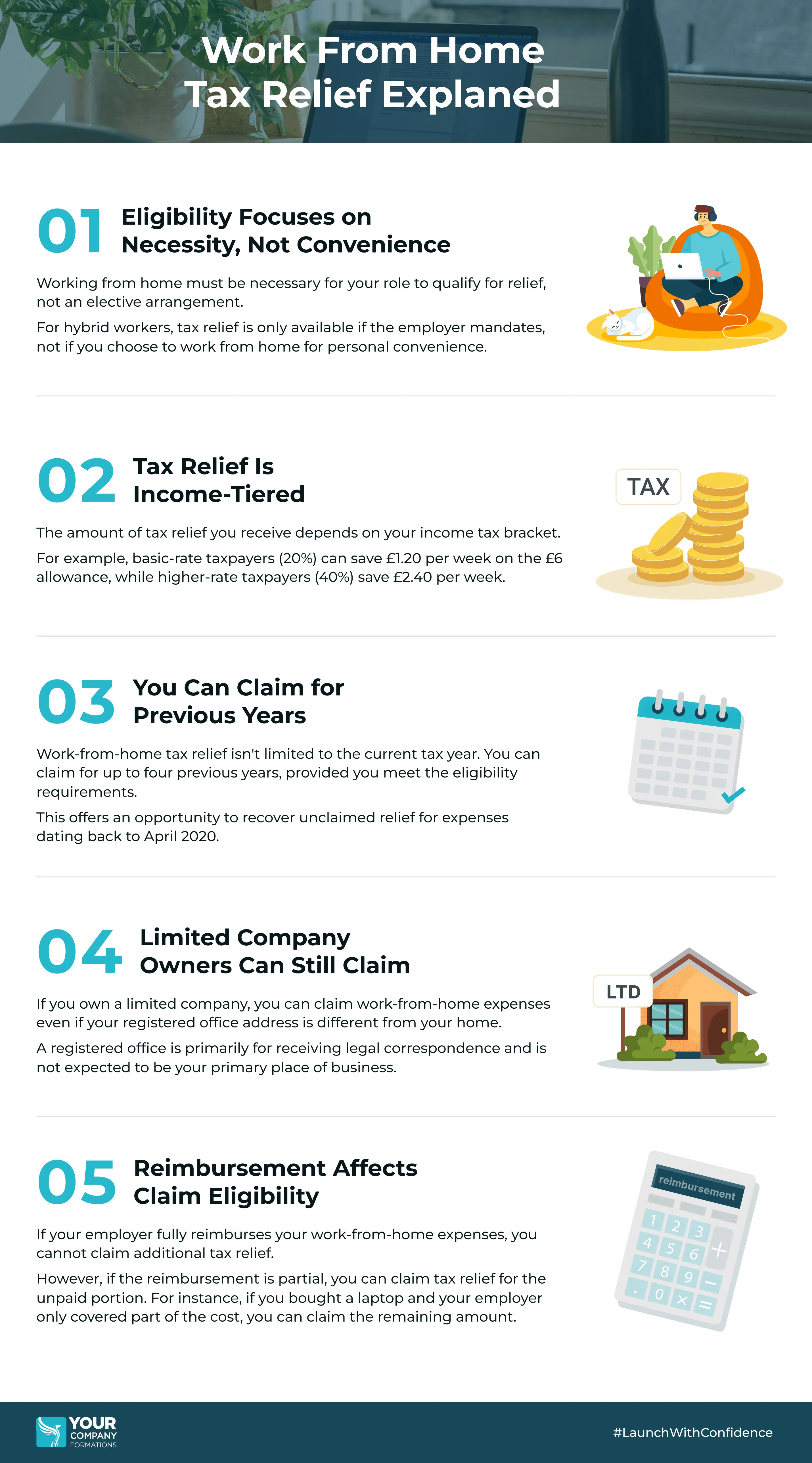
Work From Home Tax Relief Infographic
This infographic outlines the main points of claiming work-from-home tax relief in the UK. It explains eligibility based on necessity, income-tiered relief rates, rules for limited company owners, and how previous years’ claims and employer reimbursements affect entitlement.

Excellent article! I will implement this tax relief knowledge on working from home for my own professional UK accountants business.