
- Unlike sole traders, limited companies offer more credibility. Registering a limited company legally protects your business name and helps you build trust with clients, suppliers, and partners.
- A private limited company has perpetual succession, meaning it continues to exist beyond the involvement of the original founders, making it easier to sell or pass on.
- However, compared to sole traders, private limited companies must meet stricter reporting, filing, and transparency obligations with Companies House and HMRC than sole traders.
What is limited liability?
Limited liability protects business founders from personal responsibility for their business’s debts. Unlike sole traders, where owners are fully liable, limited companies separate the business from its founders. Founders risk only what they invest and earn profits proportional to that investment. This structure safeguards personal assets while limiting financial exposure.
What are private limited companies?
A private limited company is a business structure that offers limited liability, meaning its financial and legal responsibilities are separate from those of its owners. This protects personal assets if the business faces financial difficulty.
What makes a company private is that its shares are not publicly available and cannot be traded on the stock market. Ownership remains with specific individuals, such as founders, directors, or private investors.
The key features of a private limited company are:
- A company secretary is not required.
- The company can have just one director, who may also be the sole shareholder.
- You must provide details of the Person with Significant Control (PSC), who may be a director or another individual with significant influence or ownership.
- A registered office address in the UK is mandatory.
- All directors must have a correspondence address located anywhere in the world.
Private limited companies advantages
Forming a private limited company offers several benefits, starting with limited liability protection, a core feature of this business structure. Beyond this, the other advantages include:
- Registration as an individual: You can register a UK private limited company as a sole individual. This is ideal for sole traders looking to transition smoothly while maintaining full control of their business. It allows you to limit personal liability and retain all profits. It is the fastest way to incorporate a business in the UK.
- Separate legal entity: A private limited company is a separate legal entity from its owners. This distinction makes bringing in additional shareholders and raising capital easier by offering shares without affecting your personal assets.
- Tax efficiency: Private limited companies are often more tax-efficient than sole trader businesses. As a director, you can choose how to withdraw profits, such as through a mix of salary and dividends, to reduce your overall tax liability. This offers a significant financial advantage compared to operating as a sole trader.
- Branding flexibility: A limited company offers greater branding flexibility, allowing you to select a company name and build a brand that aligns with your industry or personal values as an entrepreneur. In contrast, sole traders often operate under their own names, limiting branding options and providing no legal protection for the brand. A limited company structure safeguards your chosen name and brand, giving your business a professional edge.
Disadvantages of a private limited company
While private limited companies offer many advantages, they also come with responsibilities. These disadvantages are manageable, but it’s important to understand the compliance requirements to ensure your business stays on the right side of the law.
- Higher incorporation costs: Registering a limited company with Companies House costs more than setting up as a sole trader. Sole traders can register by simply informing HMRC that they will be filing a self-assessment tax return, while limited companies must go through a formal incorporation process with associated fees.
- Public disclosure of information: Unlike sole traders, private limited companies must make certain information publicly available. Details such as the company’s financial statements, registered office address, and the names of directors and shareholders are accessible via the Companies House register. This level of transparency can be a drawback for those who prefer to keep their business affairs private.
-
Increased compliance requirements: Limited companies, including limited liability partnerships (LLPs), are subject to higher regulatory obligations than sole traders. You must meet ongoing compliance requirements such as:
- Filing annual accounts and confirmation statements with Companies House
- Keeping accurate financial records
- Preparing and filing Corporation Tax returns with HMRC
Failing to meet these obligations can lead to penalties, fines, or even being disqualified as a company director.
If the advantages outweigh the disadvantages for your situation, Your Company Formations registers your private limited company with Companies House as an Authorised Corporate Service Provider. Identity verification is handled free as part of every package.
Most companies are incorporated within 3 to 6 working hours. Formation packages start from £2.48 plus the £100 Companies House fee and include a UK registered office address, director service address, Certificate of Incorporation, and introductions to UK business banking partners.
What are the operational considerations of running a limited company?
Running a limited company involves responsibilities and obligations that ensure your business stays compliant, organised, and legally protected. Key operational considerations include:
-
Compliance Requirements: Companies House has a legal obligation to maintain transparency in the UK business landscape. Because of this, they require limited companies to:
- File annual accounts and a confirmation statement.
- Notify Companies House of any changes to company structure, such as directors, registered address, or shareholding.
- Maintain statutory registers (e.g. of directors, shareholders, PSCs).
- Report any significant changes in a timely manner.
Failure to comply with these obligations can result in penalties, fines, or director disqualification.
- Appointing and Maintaining Company Roles: You must have at least one director. While a company secretary is optional, directors are responsible for ensuring the company meets its legal obligations.
-
Corporation Tax and Financial Reporting: Limited companies must register for Corporation Tax with HMRC and file a Company Tax Return each year and:
- Keep accurate financial records.
- Submit annual accounts to Companies House.
- Pay Corporation Tax on profits.
- Ensure tax returns are submitted on time to avoid interest or penalties.
-
Payroll and Employee Responsibilities: If your company hires staff, you must:
- Register as an employer with HMRC
- Operate PAYE to manage employee income tax and National Insurance
- Comply with auto-enrolment pension rules
- Follow employment law and maintain HR documentation
-
Record-Keeping and Documentation: You must retain:
- Accounting records (for at least 6 years)
- Board meeting minutes and shareholder decisions
- Proof of transactions and communications
Good record-keeping is essential not only for compliance but also for making informed business decisions.
What is the company formation process of a limited liability venture?
To register a limited company in the UK, follow these key steps:
- Choose the right structure: Decide whether a private company limited by shares, a company limited by guarantee, or a limited liability partnership (LLP) is the best fit for your business.
- Check name availability: Use the Company name check tool to make sure your preferred name is available.
- Appoint directors and shareholders: You must have at least one director and one shareholder (they can be the same person).
- Identify persons with significant control (PSC): Check if any of the appointed individuals qualify as a PSC and include their details.
- Register with Companies House: Submit your application online or by post along with your company documents and registration fee.
Who can benefit from operating as a private limited company?
A wide range of entrepreneurs can benefit from setting up a private limited company. This structure is ideal for:
- Those who want limited liability: Individuals or groups who want to limit their liability to the amount they invest in the company.
- Business owners seeking investors: A limited company structure allows you to issue ownership shares in proportion to the investment received, making it easier to attract outside funding.
- Those planning for long-term continuity: A limited company offers perpetual succession, meaning the business can continue operating even if the original owners leave or pass away.
- Entrepreneurs looking for tax efficiency: You can take advantage of potential tax benefits, such as deferring tax payments or combining salary and dividends for more efficient income planning.
Private vs public limited companies
Choosing between a private and public limited company depends on your business goals, funding plans, and how much control you’re willing to retain. The table below outlines the main differences:
| Characteristic | Private Limited Company (LTD) | Public Limited Company (PLC) |
|---|---|---|
| Liability | Shareholders’ liability is limited to the value of their shares | Shareholders’ liability is limited to the value of their shares |
| Raising capital | Limited to private investors | Can raise funds from the general public |
| Company Secretary | Optional | Compulsory |
| Minimum Share Capital | £0 | £50,000 |
| Minimum number of shareholders | 1 | 2 |
| Disclosure requirements | Lower reporting and disclosure requirements | Higher level of transparency and reporting |
| Regulatory obligations | Less regulated | Heavily regulated by the FCA and other bodies |
| Suitability | Small to medium-sized businesses | Large businesses looking to scale or expand |
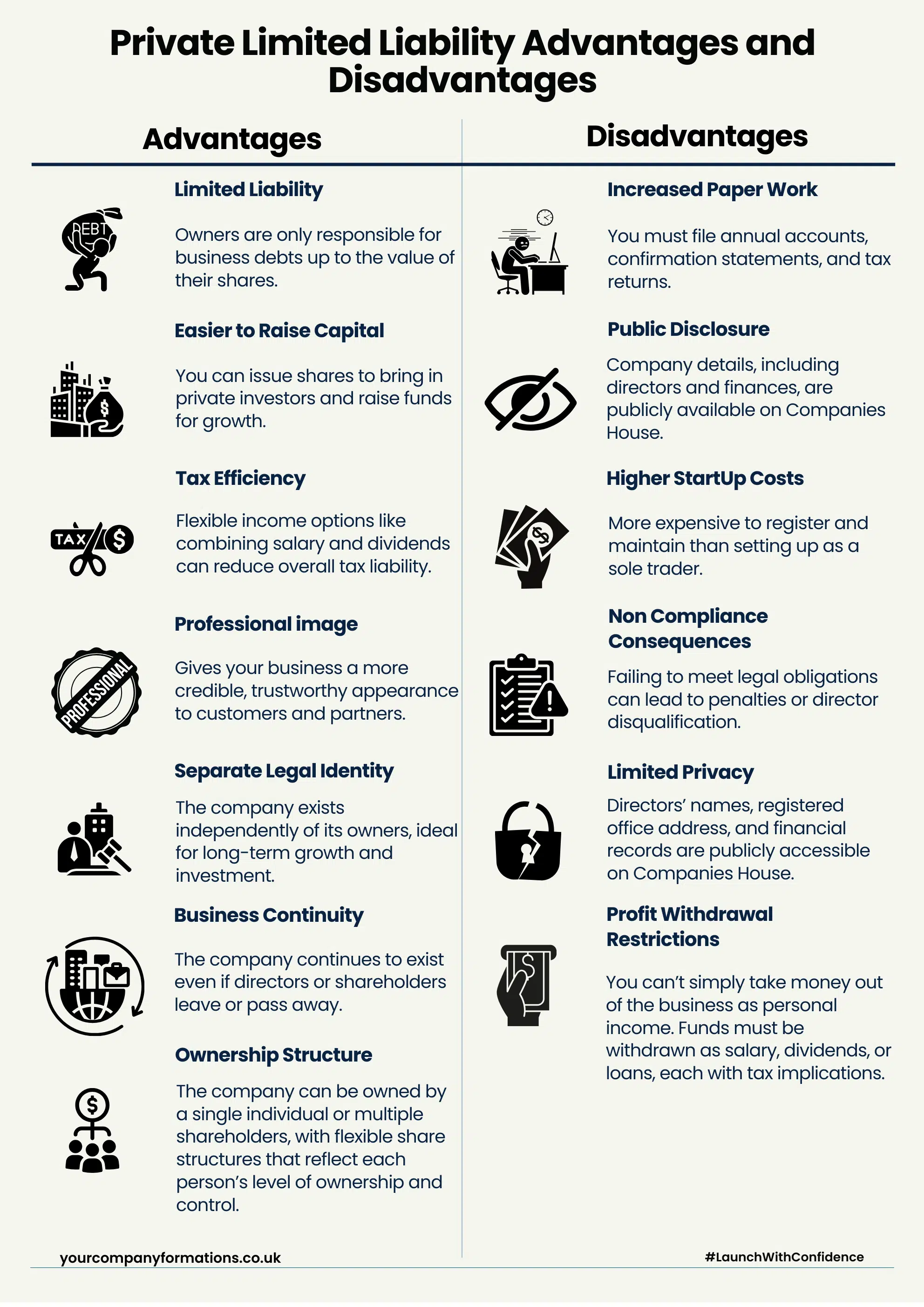
Infographic: The Advantages and Disadvantages of a Private Limited Liability Company

Your email address will not be published. Required fields are marked *