
- Your Company Formations’ free company name availability checker tool connects directly with the GOV.UK Companies House database for real-time name availability results.
- Instantly identify if your name contains sensitive words or restricted expressions and get legal naming guidance.
- Secure your preferred business name and complete your company registration in minutes, all in one place.
- Under the Economic Crime and Corporate Transparency Act 2023, Companies House can now reject names that include random characters or code meant to obscure identity, appear fraudulent or misleading to the public, or suggest false links to governments or international bodies.
Why your company name matters legally and commercially?
Your company name is more than just a label; it’s a legal identity, a marketing asset, and the first impression customers will ever have of your brand. Choosing the wrong name can lead to company name risks, compliance issues, legal conflicts, and brand confusion that damage your reputation before you even get started.
If you’re wondering how to check if a company name is available in the UK, the first thing to understand is why getting the name right matters so much in the first place.
Here’s why your business name deserves serious attention from day one:
- It defines your legal presence in the market: Your chosen name will appear on all official documentation, invoices, and legal records, becoming the official face of your business in the UK.
- It can create or destroy customer trust: A confusing, overly generic, or misleading name can deter potential customers, while a strong name fosters instant recognition and credibility.
- It determines your online and offline visibility: A unique name improves your chances of ranking in Google, securing a .co.uk domain, and avoiding conflict with other businesses.
- It must follow UK company naming rules: Specific words and formats are restricted or require special permission, and failing to meet these criteria can result in rejection.
- It can trigger unexpected legal action: Choosing a name too close to an existing brand or trademark can expose you to lawsuits or forced name changes, even after incorporation.
Companies House rejects hundreds of applications each month due to name duplication or violations of naming regulations. If your proposed name is too similar to an existing business or includes restricted words, your application may be rejected outright or, worse, accepted and challenged legally later. Always double-check for conflicts early to avoid expensive rebranding or regulatory issues.
How to Use the Company Name Search Tool to Check Availability Under Companies House Rules
Checking if your company name is available involves five essential steps: searching the Companies House register, verifying trademark conflicts, checking domain availability, ensuring compliance with naming rules, and verifying its uniqueness. Follow this process to avoid rejection and secure your preferred trading name quickly.
Step 1: Open the Company Name Checker
The fastest way to check whether your preferred company name is available is to use our free company name checker.
Alternatively, you can search the Companies House “Find and update company information” service directly.
The search results show registered companies with names that fully or partially match your proposed name, including active and dissolved companies and businesses that previously used the name.
What the search results mean:
- Your exact name appears in the list: The name is taken and unavailable
- Similar names appear: Review these carefully, as they may trigger the “too like” rule
- Companies with “Active” status: Currently operating businesses using similar names (shows incorporation date)
- Companies with “Dissolved” status: May still be unavailable during protection periods (shows dissolution date)
- Previous names shown: If a company previously used your desired name, it will appear in results even if they’ve since changed it
Use the results page to see how other companies in different industries are using similar name terms. This helps you understand potential conflicts and provides ideas for modifications that may be effective.
When you search for “company formation,” you will get results showing all companies that have the name “company formation” within their text or previous names. The search results display companies with full or partial name matches, including key details such as incorporation dates for active companies, company appointments, and dissolution dates where applicable. Ensure that your proposed company name is distinct from existing names to avoid rejection by Companies House due to similarity.
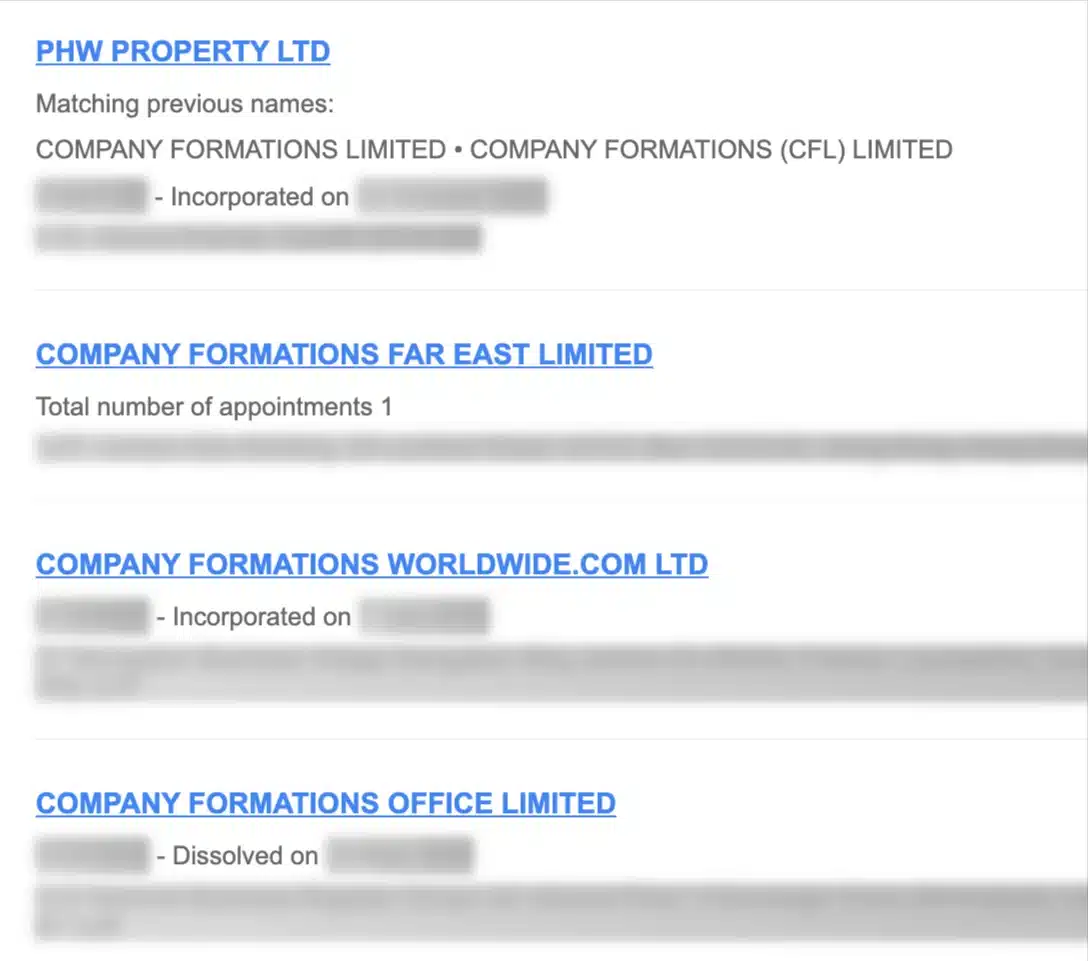
You may also search the variations of your name as well. Companies House applies the “too like” rule, meaning names that sound similar or could cause confusion may also be rejected. The registrar considers phonetic similarity, meaning, and potential for customer confusion.
Step 2: Check for “Same As” and “Too Like” Trading Names
Companies House enforces strict similarity rules to prevent customer confusion. Your name cannot be identical to or confusingly similar to existing registered names.
“Same as” rule examples that fail:
- If “Example Company Ltd” exists, you cannot register “Example Company Limited” or “Example Company UK Ltd”
- Punctuation changes don’t create uniqueness: “Smith’s Services” vs “Smiths Services”
- Adding location markers rarely helps: “London Example Co” vs “Example Co”
“Too like” rule considerations:
‘Easy Electrics For You Ltd’ is the same as ‘EZ Electrix 4U Ltd’ according to Companies House guidelines. What triggers similarity reviews includes abbreviations that sound identical when spoken, different spellings of the same word (“centre” vs “center”), number substitutions for letters (“4” for “for”, “2” for “to”), and reordering the same core words.
Companies House reviews questionable similarities on a case-by-case basis. When in doubt, choose a more distinctive name to avoid delays and rejections.
With the appropriate documentation, the ‘same as’ rule will be waived for you if:
- Your proposed company will be part of the same group as the existing company with the identical name.
- The existing company consents to the registration of the identical name.
- Your application to register the name includes a written statement from the existing company confirming its consent and indicating that the proposed company will be part of the same group.
Step 3: Verify No Sensitive Words and Expressions Apply
Certain words require government approval before use in company names. Sensitive words and expressions that require prior approval include terms suggesting government connections, professional qualifications, or royal associations.
Common sensitive words requiring permission:
- Royal connections: King, Queen, Royal, Prince, Princess, Duke, Duchess, Windsor
- Government implications: British, National, Authority, Commission, Department
- Professional terms: Bank, Insurance, Architect, Pharmacy, Solicitor
- Status indicators: Institute, Academy, Foundation, Trust, Federation
See also: Full List of Sensitive Names and How to Get Approval
How to get permission:
Contact the relevant authority before submitting your application. For royal words, email royalnames@cabinetoffice.gov.uk. For financial terms, contact the Financial Conduct Authority. Each department has specific requirements and timelines.
The permission process typically takes 2-4 weeks. Factor this into your incorporation timeline. Include the approval letter with your Companies House application to avoid automatic rejection.
At Your Company Formations, we help clients understand which authorities to contact for sensitive word approvals. Our team can review your proposed name and flag potential issues before you submit formal requests.
Step 4: Confirm Your Name Won’t Cause Offence
Your company name cannot be offensive, inappropriate, or likely to cause harm or offence to any group or individual. Companies House aims to approve enterprises that promote inclusivity and respect in the business community.
Our limited liability company name checker UK tool will flag names that are offensive, inappropriate, derogatory, or likely to cause harm or offence. Context matters here; global events, cultural sensitivities, and evolving social attitudes can make previously acceptable names problematic.
Companies House teams consider changing social attitudes when reviewing questionable names. What seemed acceptable in previous years might be rejected today due to evolving public sentiment and stricter enforcement standards.
Step 5: Ensure Your Name Doesn’t Suggest Criminal Activity
Your proposed name must not suggest criminal activity or go against the public interest. To maintain a positive business image, adhere to legal requirements, and promote decency in the UK business environment, choose a commercial name that avoids implying illegal activities, fostering discrimination or bias, or anything that goes against public welfare.
Names that could facilitate illegal activities or suggest involvement in prohibited trades will be automatically rejected. Companies House takes a firm stance on maintaining the integrity of the business register and protecting public trust in legitimate businesses.
Read more: Limited Company Name Change by Special Resolution Explained!
Step 6: Search the Trademark Register
Companies House doesn’t check trademarks during name registration. A name might be available for company registration, but still infringe existing trademark rights, potentially leading to legal action later.
Check the UK Intellectual Property Office UK trademark register:
- Visit the IPO’s trademark search tool online
- Search for your exact name and variations
- Check similar businesses in your industry sector
- Review both registered and pending applications
What to look for:
- Identical names in any business category
- Similar names in your planned business sector
- Phonetically similar marks
- Names that could cause customer confusion
Consider international protection as well. If you plan to trade internationally or online, search major trademark databases, including the EU Intellectual Property Office and the World Intellectual Property Organisation systems.
Even if no identical trademark exists, consider registering your company name as a trademark for additional protection. Doing this grants you exclusive rights over your brand identity, which is crucial for marketing purposes. Learn more about trademark protection in our detailed guide: What is a Trademark?
Step 7: Domain Name and Social Media Availability
Your company name should ideally match your digital presence. Check to consider that it is also available as a domain name and social media handles before finalising your choice.
Customers expect to find you easily online. Mismatched names between your company registration, website, and social media create confusion and can hurt your professional image.
Domain checking priorities:
- Secure .co.uk and .com if available
- Check common variations (.org, .net, .london)
- Consider hyphenated versions as backup options
- Verify the domain isn’t parked by competitors
Social media username consistency:
- Check Facebook, LinkedIn, Twitter, Instagram availability
- Look for existing businesses using similar handles
- Consider how the name appears in search results
- Verify it’s not associated with negative content or impersonation
- Namechk: Best all-in-one tool to check domains + social usernames instantly
- GoDaddy UK: Great for buying and managing .co.uk and .com domains
- BrandSnag: Tells you which names are taken on top platforms, including YouTube and TikTok
- Knowem: Best for large-scale social username audits (500+ platforms)
- Instant Domain Search: Ideal for fast searches and seeing premium alternatives
The goal isn’t just to be available, it’s to have a consistent brand presence.
When customers Google you, every result should clearly and professionally reflect your brand. That’s how you build recognition and trust from day one.
What happens if you check a company name availability and find it’s taken?
So, you’ve found the perfect company name… but it’s already taken.
Don’t panic, this is more common than you think, and it doesn’t mean you need to start from scratch.
When a name is not available in the UK, it’s usually because it’s already registered with Companies House or protected as a trademark. But with a few smart tweaks, you can still find a unique company name that works just as well and complies with UK regulations.
Here are some effective business name alternatives to consider:
- Add your industry or niche: If “Thrive Solutions” is taken, try “Thrive Marketing Solutions” or “Thrive HR Solutions”.
- Use your location: “Oakwood Interiors” becomes “Oakwood Interiors London” or “Oakwood Interiors UK”.
- Incorporate your initials or full name: Especially useful for freelancers or consultants (e.g., “JL Consulting Group”).
- Include a unique word or modifier: Adding words like “Group,” “Collective,” or “Lab” can make a generic name more distinctive.
- Use abbreviations or acronyms: These can be more memorable and flexible for branding (e.g., “BrightPath Ltd” becomes “BP Solutions Ltd”).
- Change the word order: “Fusion Creative” vs. “Creative Fusion” can make all the difference in availability.
Please note that all name modifications must still comply with UK company naming regulations. Avoid offensive terms, misleading claims, or any wording that implies a connection to government, royalty, or professional bodies unless you have written permission.
Final tips for choosing a compliant and strong business name
Now that you’ve explored availability, trademark safety, and online branding, it’s time to refine your final decision. These aren’t just tips; they’re essential rules and smart brand strategies that every UK business should follow before locking in a name.
Utilise these company name best practices to ensure your name is both legally compliant and well-positioned for long-term brand strength.
Do this
- Check against the full Companies House naming rules: Your name must not be offensive, misleading, or imply a connection with the UK government, local authorities, or regulated professions (like “Bank” or “Charity”) unless you have written approval.
- Use protected terms only if you have a legitimate reason: Words like “Association,” “Trust,” “Institute,” and “Royal” are restricted. If used improperly, your application will be delayed or rejected.
- Choose a name that signals professionalism and purpose: Your business name isn’t just for now; it appears on contracts, invoices, and legal documents. Pick something you’d be proud to say out loud in a boardroom.
- Plan for international growth, even if you’re starting local: Many businesses register region-specific names like “Leeds Print House”, only to find they need a broader identity a year later. Choose flexibility where possible.
- Validate your name across every critical platform before registering: A strong brand name must be available across Companies House, trademark databases, web domains, and social media handles. If you skip this, you risk diluting your brand or being forced to change its name.
- You do not have to use ‘limited’ in your name if your company is a registered charity or company limited by guarantee and your articles of association say your business that your company cannot pay shareholders.
Avoid this:
- Recycling an existing brand’s identity, even “by accident”: If your name is even visually or phonetically similar to a registered brand, you could be served a legal notice, or forced to rebrand after launch.
- Using initials alone does not convey your business value proposition to customers: “ABC Solutions Ltd” might be easy to register, but does not tell your audience much about your business. It’s forgettable, difficult to search, and poorly optimised for SEO.
- Getting clever with spelling or symbols: Spelling “Quick” as “Kwik” or replacing letters with numbers might seem creative, but it almost always confuses users, weakens trust, and hurts visibility.
- Choosing overly trendy names with a short shelf life: Slang, pop culture references, and trend-based names date quickly. What feels cool now might sound out of place in five years.
- Ignoring the legal requirement for a company ending: In the UK, private limited companies must end their name with “Limited” or “Ltd.” Forgetting this or using the wrong structure can delay your registration or require resubmission.
- Registering before you’re ready: One of the biggest mistakes new founders make is rushing to incorporate a name before doing a full domain, trademark, and naming rules check. Always run a complete pre-check workflow first.
A smart name isn’t just available, it’s defensible, memorable, future-proof, and fully compliant with UK law. Follow these naming tips for UK business owners, and you’ll avoid unnecessary setbacks while building a brand that can grow with you.
Frequently Asked Questions
How do I check if a limited company name is available to register?
Enter your proposed name into our company name checker to search the live Companies House register. The checker also considers the “same as” and “too like” rules that can affect registration. You should also check for trademarks, domain availability, and any sensitive words that may require approval.
Is it possible to register your company name without forming a company?
No, you cannot reserve company names separately in the UK. Name registration happens during company formation. However, you can protect your preferred name by registering it as a trademark through the IPO or purchasing the matching domain name to prevent others from using it until you’re ready to incorporate.

Your email address will not be published. Required fields are marked *