

- The J30 transfer form is the legal instrument required to transfer shares in a private company limited by shares.
- The buyer is responsible for calculating and paying Stamp Duty if the sale price exceeds £1,000.
- Stamp Duty is charged at 0.5% of the sale price, rounded up to the nearest £5.
- The buyer must email the signed form to HMRC within 30 days of the date the seller signed it.
- HMRC no longer accepts physical submissions by post.
- The board has up to two months to approve or refuse the transfer after the buyer lodges the documents.
- Legal ownership transfers at the exact moment the buyer’s name is entered into the company’s register of members.
- If the transfer creates a new Person with Significant Control, the company must notify Companies House within 14 days of the register being updated.
The J30 is the Standard Legal Instrument for Transferring Shares in a UK Private Company
A UK limited company cannot legally transfer share ownership without a J30 form. Section 770(1) of the Companies Act 2006 requires a buyer to deliver a “proper instrument of transfer” to the company before it updates its register.
Without this complete document, the company has no legal authority to change its register of members.
How to Complete the J30 Stock Transfer Form: Seller Initiates, Buyer Completes
For the form to be legally valid, the seller completes the top half of the transfer form to initiate the share transfer, and the buyer completes the bottom half.
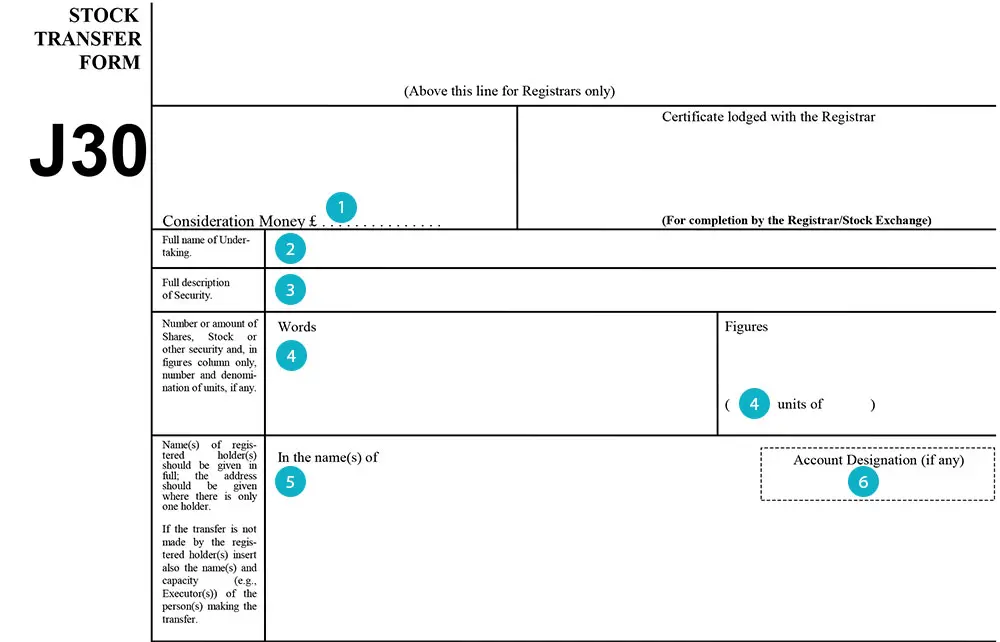
1. Enter the Price Paid (Consideration)?
Enter the exact sale price in pounds and pence (e.g., “5000.00”) in the Consideration box. Write “Nil” if no money changes hands. The field must not be left blank.
2. The Company Name Must Match the Companies House Record
Enter the full registered company name whose shares are subject to the transfer exactly as it appears at Companies House.
3. Use the Exact Share Class Description from the Company Register
Describe the type of shares being transferred (e.g., “Ordinary Shares of £1 each”). The description must match the company’s register of members and share certificates exactly to avoid rejection.
4. Specify the Number of Shares in Words and Figures
State the share quantity in both the Words and Figures columns (e.g., “One Hundred” and “100”). Add the share denomination in the units field if applicable (e.g., “£1 each”).
5. The Seller’s Name Must Match the Share Certificate Exactly
Enter the seller’s full legal name as it appears on the share certificate and the company register. A sole seller must also include their current full postal address. List all names if the shares are held jointly. An executor signing for a deceased shareholder must state their own name and capacity (e.g., “Executor of the Estate of [Name]”).
6. Leave account designation blank for most private transfers
Leave the field blank. It applies only to nominee or trust arrangements and is rarely relevant for a standard private company transfer.
7. An Unsigned or Undated Form Has No Legal Effect
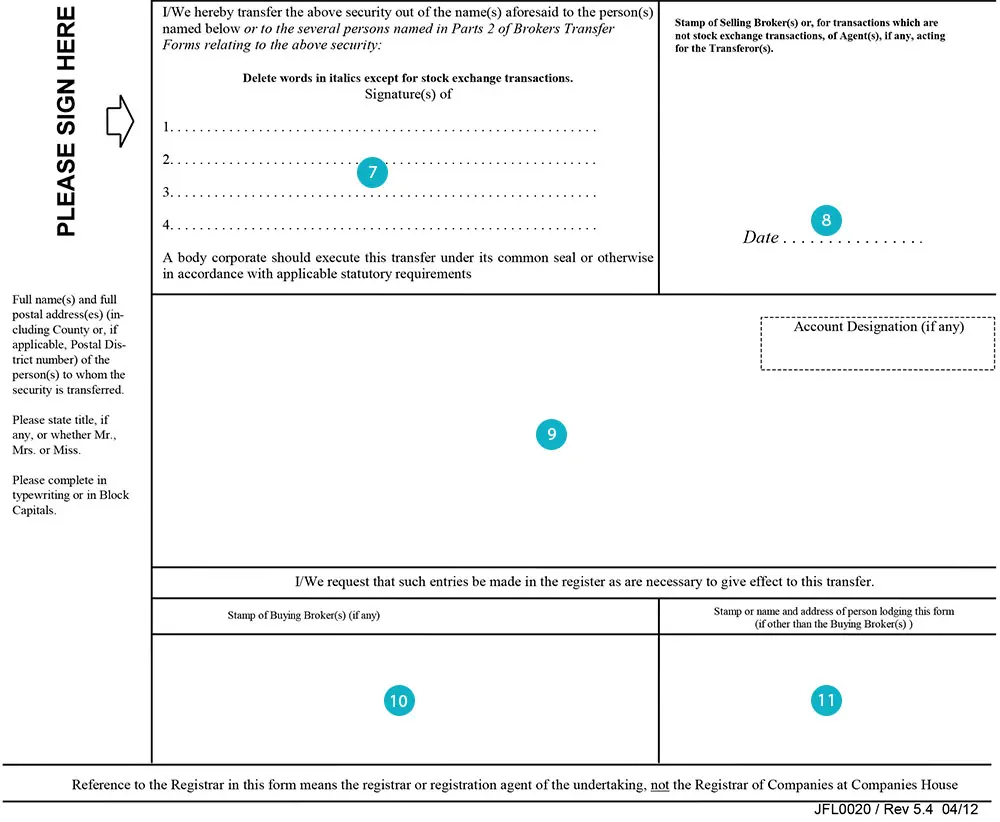
Every registered holder named in field 5 must sign the document. A company transferring shares must execute the form under its common seal or in accordance with the Companies Act 2006, typically with two directors’ signatures. The seller must include the signing date. HMRC accepts electronic signatures, including those from overseas services such as DocuSign, submitted as a scanned PDF. The buyer does not need to sign the form for the transfer to be valid.
8. Selling Broker Box Does Not Apply to Private Companies
Leave the Stamp of Selling Broker(s) box blank. The box is intended for stock exchange transactions only.
9. Buyer Completes the Bottom Half in Block Capitals
Enter the buyer’s full legal name, title (e.g., Mr, Mrs, Dr), and full postal address in block capitals or typewriting. List all names and addresses if multiple buyers are acquiring the shares jointly. A corporate buyer must provide its full registered name and registered office address
10. Buying Broker Box Does Not Apply to Private Companies
Leave the Stamp of Buying Broker(s) box blank. The field is optional and is not used for private share transfers.
11. Name the Person Who Will Lodge the Form with the Company
Enter the buyer’s full name and address if lodging the form directly. A solicitor acting on the buyer’s behalf should enter their firm’s contact details instead
Cross-check every detail against the register of members and the existing share certificate before signing. Misspelt names, outdated addresses, or an incorrect share class will cause HMRC or the company to reject the form. An undated form is invalid and will be rejected.
Stamp Duty is Only Owed if the Sale Price Exceeds £1,000
The buyer is solely responsible for calculating Stamp Duty and submitting the form. How to calculate Stamp Duty depends entirely on whether the sale price, or ‘consideration’, for the share transfer exceeds £1,000.
If Consideration Exceeds £1,000, Pay 0.5% Stamp Duty and Email the Form to HMRC Within 30 Days
The buyer calculates 0.5% of the consideration price for the transaction and rounds that figure up to the nearest £5. A duty of £21.50 becomes £25, while a duty of £50 stays at £50.
The buyer then:
- Pay the duty online: The buyer pays the calculated Stamp Duty to HMRC via its online service on GOV.UK. HMRC issues a unique payment reference upon payment.
- Email the signed form to HMRC: Send a scanned copy of the signed J30 to HMRC’s stamp duty mailbox and include the unique payment reference in the email. HMRC no longer accepts submissions by post.
- Meet the 30-day deadline: The form must reach HMRC within 30 days of the date the seller signed it. Missing the deadline can result in penalties.
- Await stamped confirmation: HMRC emails back a letter confirming the form is duly stamped. The process takes 15 to 20 working days. The buyer cannot proceed to the next step without that letter.
If the consideration is £1,000 or less, sign Certificate 1 and send the form directly to the Company
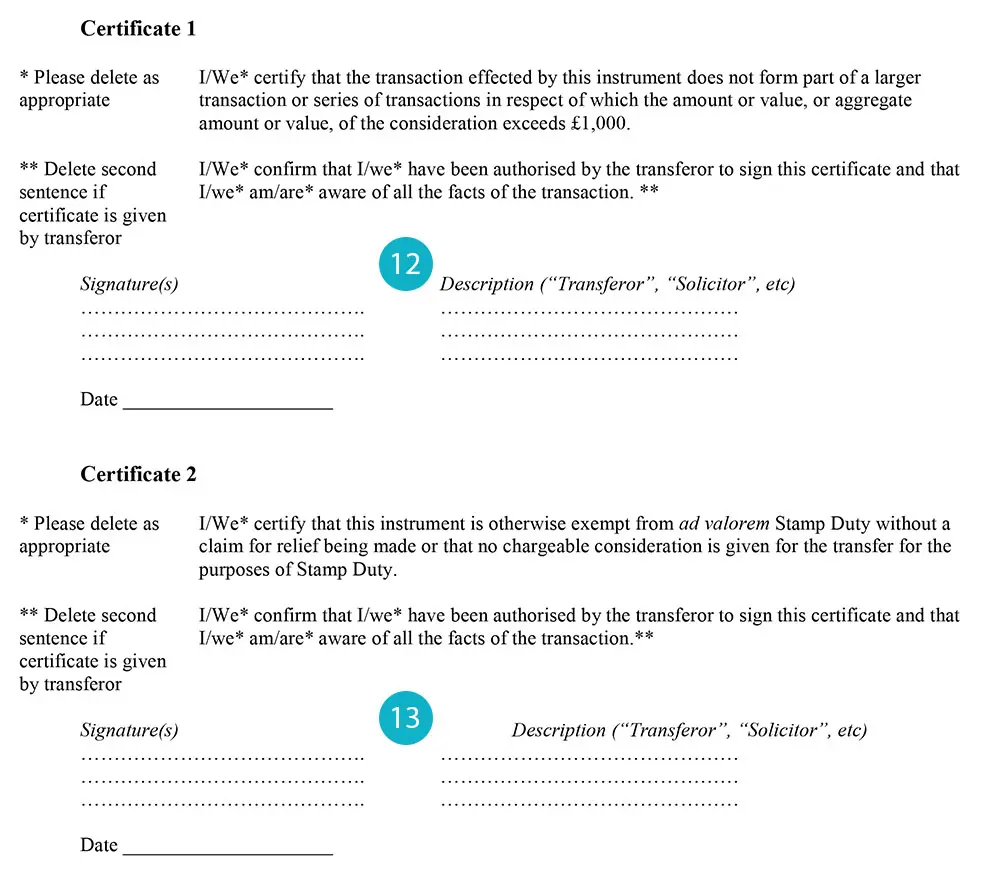
The share transfer is exempt from Stamp Duty. The buyer signs and dates Certificate 1 on the reverse of the form, writes “Transferee” in the Description field, and deletes the second sentence of the certificate. A solicitor signing on the buyer’s behalf writes “Solicitor” in the Description field and leaves the second sentence intact. The completed form goes directly to the company without HMRC involvement.
When the transfer is a genuine gift, sign Certificate 2
The transfer is exempt from Stamp Duty. The buyer signs Certificate 2 on the reverse of the form, dates it, and writes “Transferee” in the Description field. A nominal £1 sale does not qualify for Certificate 2. It qualifies for Certificate 1, because £1 is a consideration, not nil consideration. The form goes directly to the company.
If shares are exchanged for a non-cash asset, establish a market valuation before calculating stamp duty
The buyer must establish a clear market valuation of the asset as of the date of transfer before calculating Stamp Duty. Our separate guidance on how to value the shares of a private company details the methods HMRC will accept. The buyer then calculates Stamp Duty of 0.5% on that valuation, assuming it exceeds £1,000, and must retain records of how the valuation was reached. Transfers involving non-cash assets require professional legal assistance to ensure correct valuation.
Group Relief and Pre-2020 Forms Still Require HMRC Submission
Even when a transfer qualifies for group relief and no duty is payable, the buyer must still complete the form and submit it to HMRC for adjudication. HMRC will assess the claim and, if approved, issue a letter confirming the form is duly stamped but exempt from payment. The buyer cannot skip the HMRC submission step on the assumption that relief will be granted.
A physically signed stock form from before March 2020 remains a valid instrument of transfer. If Stamp Duty is payable on this older version, the buyer must scan the document and email it to HMRC, as the electronic submission rule still applies. The original handwritten signature on the scanned document remains legally valid. For complex cases, seek professional assistance to prevent costly errors.
The Board Has Two Months to Approve or Refuse the Transfer
The buyer is responsible for assembling and delivering the complete document package to the company. The board’s approval is the final gate before legal ownership changes hands.
- Assemble the required documents: Gather the original signed J30 form, the HMRC letter confirming the form is duly stamped (if Stamp Duty was paid), and the seller’s original share certificate. If the seller has lost the certificate, they must provide a signed letter of indemnity, which you add to the package instead.
- Deliver the package to the registered office: Send the complete document package to the UK company’s registered office address.
Once you lodge the documents, the company’s directors must review and approve the transfer, usually at a board meeting. Directors have up to two months from the date of lodging to make their decision. They may refuse a transfer only on legitimate grounds set out in the company’s articles of association, such as enforcing pre-emption rights or preventing a transfer that conflicts with the company’s interests.
A company’s articles of association may restrict transfers through pre-emption rights, which require the seller to offer shares to existing shareholders before selling to a third party. The seller must check the articles before agreeing to any transfer. Bypassing pre-emption rights invalidates the transaction entirely, even after Stamp Duty has been paid.
Legal Ownership Transfers the Moment the Register is Updated
The board’s approval does not transfer ownership. A company director must complete three statutory actions to finalise the transaction, with legal ownership passing to the buyer only after the company register is updated.
Enter the Buyer’s Name in the Register to Transfer Legal Ownership
A UK company’s statutory register is now the single, definitive legal record of share ownership. The Economic Crime and Corporate Transparency Act 2023 abolished the option to hold a parallel register at Companies House, leaving your internal document as the sole source of truth.
A director transfers legal ownership by entering the buyer’s details into the statutory register of members. The director must include a service address for the new member, a requirement under the ECCTA.
Any delay or error in a director’s update of the register leaves the share transfer legally incomplete.
Cancel the Seller’s Certificate and Issue a New One Within Two Months
The director cancels the seller’s original share certificate and issues a new certificate in the buyer’s name within two months of the buyer lodging the transfer.
Notify Companies House of Any PSC Changes Within 14 Days
If the transfer creates a new Person with Significant Control (PSC), the director updates the company’s PSC register. The director then notifies Companies House of the change within 14 days of updating the register of members. Report other shareholding changes on the company’s next confirmation statement.
Owning UK Shares Does Not Give a Non-Resident the Right to Work in the UK
UK law permits international founders to own and transfer company shares. HMRC accepts electronic signatures from overseas services such as DocuSign for stamping. Non-resident sellers are exempt from Capital Gains Tax (CGT) on UK shares, though residency status under the statutory residence test determines the precise position.
Owning shares in a UK company does not grant the right to work or reside in the UK. A share transfer confers no immigration rights on the buyer.

Your email address will not be published. Required fields are marked *