
- Those in self-employment pay both Class 2 and Class 4 National Insurance contributions (NICs), with Class 2 being partially abolished for those whose profits exceed a certain threshold.
- Those with profits below £6,725 are not automatically deemed to have paid Class 2 NICs and may choose to pay to retain their entitlement to state benefits.
- The amount of Class 2 contributions is £3.45 per week for the 2024/25 tax year.
Class 2 NI contributions are a vital component of the UK’s tax system for self-employed individuals. Traditionally, these flat-rate contributions were designed to help fund essential state benefits, such as the State Pension and Maternity Allowance.
Although recent reforms have partially abolished Class 2 NI, they still significantly protect certain taxpayers and ensure continued entitlement to contributory benefits.
What are class 2 national insurance contributions?
Class 2 NI are flat-rate weekly payments made by most self-employed individuals between 16 and the State Pension age. These contributions entitle individuals to certain state benefits. The contributions provide entitlement to contributory state benefits such as the State Pension, Maternity Allowance, and Employment & Support Allowance.
See also: How to Register for Self Assessment Tax Return on GOV.UK.
Class 2 NICs are payable based on your profits for a specific financial year as follows:
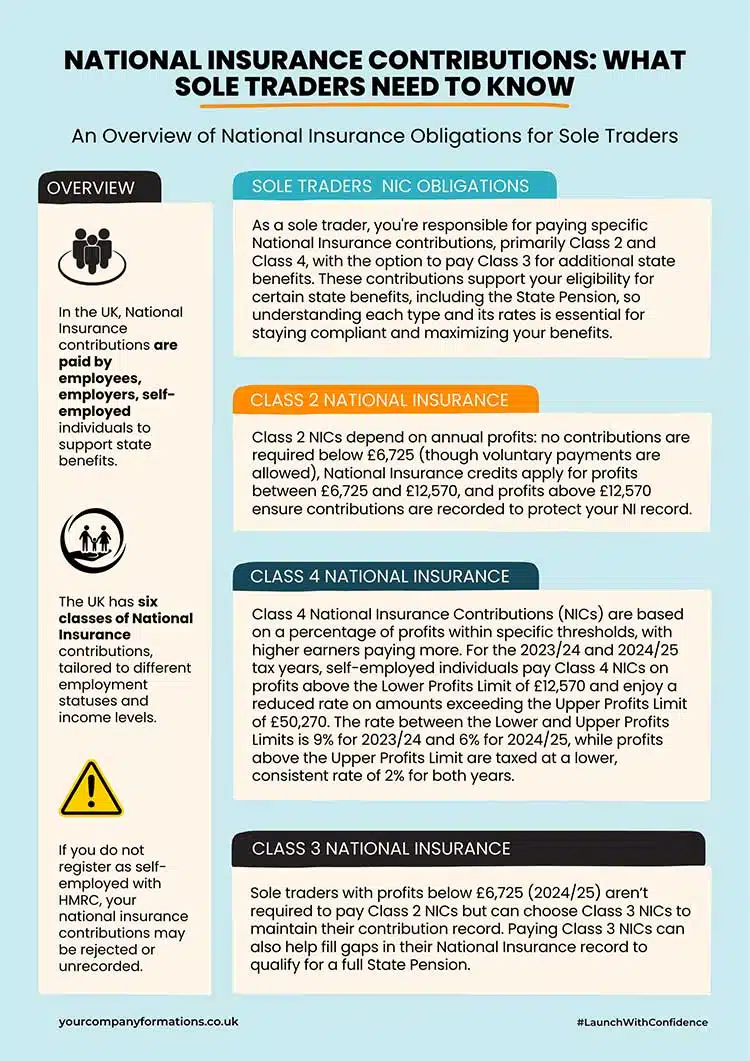
- If your profits are below £6,725, you are not required to pay Class 2, but you can make voluntary contributions.
- National Insurance credits are given to those with profits between £6,725 and £12,570. These credits count toward qualifying years for state benefits without requiring payments.
- If your profits exceed £12,570, your Class 2 contributions are treated as having been paid to protect your National Insurance record.
How much are Class 2 NICs for 2023/24 and 2024/25?
For both the 2023/24 and 2024/25 tax years, Class 2 NI contributions are set at £3.45 per week, amounting to £179.40 for an entire year (52 weeks), at the Small Profits Threshold of £6,725 annually.
Who needs to pay class 2 contributions?
On 6 April 2024, self employed individuals with profits above £12,570 will no longer have to pay Class 2 NI but will still be entitled to contributory state benefits. National Insurance credits are automatically given to those earning between £6,725 and £12,570 to secure their entitlement to contributory benefits, including the State Pension and other support.
Individuals with profits below £6,725 do not need to pay Class 2 national insurance. However, they can make voluntary contributions at £3.45 per week to secure their entitlement to state benefits. This option helps lower earners protect their National Insurance record and qualify for the same benefits as those with higher earnings.
According to the government, if Class 2 NICs were to be abolished, low-income self employed individuals would need to pay the more expensive Class 3 NICs (£17.45 per week) to maintain benefit entitlements.
See also: Sole Trader Explained.
What are class 4 NI payments?
Class 4 NICs are calculated based on a percentage of earnings within set thresholds. The rates are structured to ensure that higher earners contribute more, with a reduced rate for profits exceeding the Upper Profits Limit.
Below is a breakdown of the 2023/24 and 2024/25 tax years rates.
| £ per year | 2024/25 | 2023/24 |
|---|---|---|
| Lower Profits Limit Self-employed people pay Class 4 National Insurance on profits above the Lower Profits Limit. | £12,570 | £12,570 |
| Upper Profits Limit Self-employed people pay a lower rate of Class 4 National Insurance on profits above the Upper Profits Limit | £50,270 | £50,270 |
| Rate between Lower Profits Limit to the Upper Profits Limit | 6% | 9% |
| Rate above Upper Profits Limit | 2% | 2% |
What is the difference between class 2 and class 4 NIC?
Both are self-employed national insurance contributions. The difference depends on the benefits each contributes to, the threshold for contributing to each class and your overall NI records.
The differences are outlined below.
| Difference | Class 2 NI | Class 4 NI |
|---|---|---|
| Who pays | Self employed individuals with income below £6,725 pay voluntarily | Self-employed with profits of more than £12,570. |
| Rate | £3.45 per week. | 6% on profits £12,570 – £50,270; 2% above £50,270. |
| Benefit entitlement | State Pension, Maternity Allowance, Employment & Support Allowance. | Contributes to your overall NI record. |
| Deemed payment | Contributions are deemed to be paid for those earning between £6,725 and £12,570. | No deemed payments are based purely on actual contributions. |
| NI credits | National Insurance credits are given to those with profits between £6,725 and £12,570. | No National Insurance credits available. |
When is class 2 NIC due?
If you do not pay Class 2 NIC through Self-Assessment, you will need to register with HMRC to make these payments. Once registered, HMRC will send you a payment request by the end of October detailing how much you need to pay.
The request will specify the deadline by which you must pay HMRC. Be sure to allow enough time for your payment to be processed before the deadline, as the processing time can vary depending on the payment method you choose. However, a person with more than one job can defer paying national insurance until after the end of the tax year.
How should I pay HMRC voluntary class 2 nic?
Several payment methods are available for those who want to pay voluntary Class 2. When selecting a process, consider the processing times to ensure your payment reaches HMRC on time.
Below is a breakdown of the available payment options and timelines.
| Payment methods | Processing timeline. |
|---|---|
| Online or Mobile Banking (UK Residents) | Up to 2 hours |
| CHAPS (Clearing House Automated Payment System) | Same working day |
| Bacs (Bankers’ Automated Clearing System) | 3 working days. |
| Direct debit | 3 working days |
| Standing order | 3 working days |
| HMRC Bank Details for Faster Payments, CHAPS or Bacs | |
What are the NIC obligations for the employed and self-employed?
Self-employed individuals are responsible for paying both Class 2 and Class 4 national insurance based on their profits. In contrast, employed individuals pay Class 1, with contributions divided between the employee and the employer. The employee’s portion, known as the primary contribution, is deducted directly from their salary, while the employer pays an additional amount, known as the secondary contribution, on the employee’s behalf. This system ensures both parties contribute toward the employee’s National Insurance record and future benefit entitlements.
See also: GOV.UK Employer PAYE Reference Number 2024 Explained!

how to know if I am registered as a self employed sole trade and to pay NIC class 2 during my self assessment?
Please check your registration status in your Government Gateway account.
I am a self employed (sole trade) If I have my UTR number, does it mean that am registered to pay NIC class 2 in mu self assessment or still I have to apply to register for my NIC class 2 in my self assessment?
If you have a UTR number, it means you are registered for Self Assessment. You still need to register for Class 2 National Insurance, as this is a separate process.
Robert, the latest (discovered) NI loophole where Kiwis/Aussies working in the UK for say 10 years (then up sticks and go home) , can voluntarily contribute to missing years with Class2 ~GBP179/yr to realise a full British pension. Whereas in my situation as being a Kiwi with 15 years in London /permanent as a Class1 contributor, am stung with ~850+quid /year to make up the missing 20years. Seems a little unbalanced. Thoughts?
Good article, btw.
Cheers,
Murray
I’m really confused. I earn less than £6725, complete a self-assessment every year, the return gives the option to pay voluntary contributions but throws up an error because £0 is due. To compound this, my gov.uk record states I’ve paid pull years throughout my working life – I’m 53, and my state pension forecast says I’ll be entitled to full state pension. This makes no logical sense. I don’t claim any benefits as my husband earns enough.
Excellent article! It was helpful learning about the national insurance contributions for my own financial services UK.