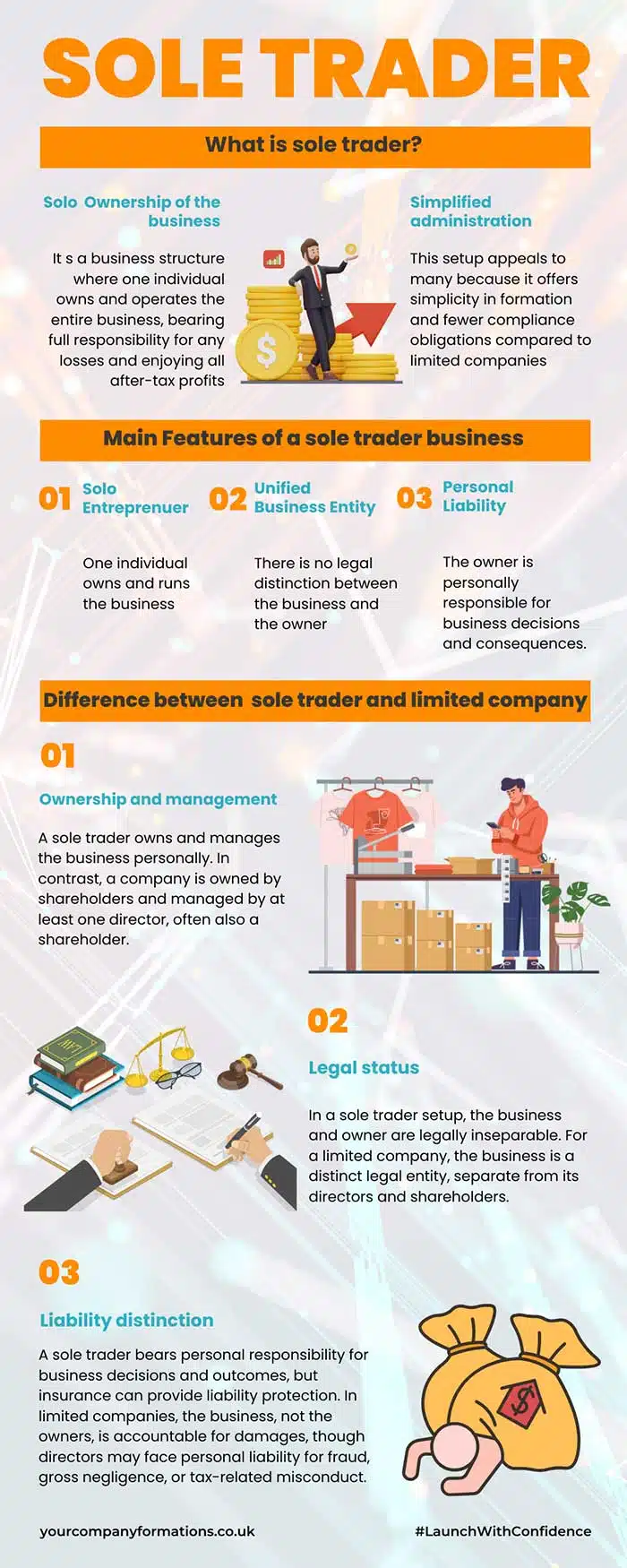
- A sole trader is a business structure in which one individual runs and owns the entire venture, is personally responsible for any losses the business incurs, and takes home all the after-tax profits.
- Some may prefer to run a business as a sole trader due to the simplicity of formation and the reduced burden of compliance requirements.
What is a sole trader business structure?
A sole proprietor, also known as a sole trader, is a business structure in which one entrepreneur runs the business with complete autonomy. Since the venture and the owner are legally inseparable, the individual bears unlimited liability, meaning he or she is personally responsible for any outstanding debts or legal obligations.
While such a structure offers significant advantages in decision-making, allowing the business owner to guide the business in any direction they choose, it comes with a significant trade-off: personal liability. If the company faces financial difficulties, the trader’s personal assets could be used to cover debts.
Advantages of Being a Sole Trader
A sole trader business has multiple advantages, the main one being that you maintain overall strategic control of your business.
Additional benefits include –
- Simple and affordable: You do not need to register with Companies House. However, once you become eligible, you must inform HM Revenue and Customs that you are a sole trader by submitting a self assessment tax return.
- You keep all the profits the business makes: Since the company is yours and you operate under your name, you keep all profits after tax.
- Increased privacy: Unlike in a limited company where company financials are published by Companies House search service., a sole proprietorship’s financial information is privately held.
- Flexibility: As a sole trader, you’re self-employed, which means you have complete control over your business operations. Consequently, the venture can enjoy rapid growth without the restrictions that sometimes impede a limited corporation.
Disadvantages of a Sole Trader Business Structure
Besides being directly responsible for business losses, liabilities, and obligations, additional disadvantages of operating as a sole trader type of business include —
- There is no legal separation between you and your business: Unlike a limited company, you are personally liable if something goes wrong. This means you are fully responsible for any harm caused to individuals or organisations dealing with your business.
- Raising startup capital is challenging: Funders and banks will likely perceive your business as a one-person show with no formal decision-making process. Furthermore, the business structure makes it impossible for them to offer you money in exchange for equity or a stake in your company.
- Constraints in tax planning: In a sole proprietorship, business profits are treated as personal income and are subject to tax in the same year earned. Sole traders have few options for reducing tax liability.
- Personally liable for business debts: The business owner bears direct responsibility for the business’s financial obligations. Personal assets, including savings and property, are exposed if the company faces financial challenges and lacks the resources to meet its commitments.
How to Register as a Sole Trader with HMRC
Setting up as a sole trader is straightforward. If you haven’t yet earned over the trading allowance, there’s no formal registration required. Once your income exceeds that threshold, follow the steps below to register and meet your tax obligations.
- Choose a Business Name: You may trade under your own name or a separate business name, but avoid anything offensive or too similar to existing trademarks. Using a different name becomes your trading name, which is usually written as “T/A” (Trading As). For instance, if your legal name is Connor James and your business is Boots and Sandals Ventures, you would present it as “Connor James T/A Boots and Sandals Ventures” on official documents like invoices, contracts, and tax filings.
- Inform HMRC That You’re Self-Employed: Register for self-assessment and Class 2 National Insurance through the HMRC online portal using your government gateway user ID. Do this as soon as you start trading or earning income.
- Register for VAT (If Required): Sign up for VAT if your taxable turnover exceeds £90,000 in 12 months. You can also register voluntarily if it suits your business.
- Apply for Relevant Licences or Permits: Depending on your industry, you may need licences (e.g. food handling, waste disposal, street trading). Check local authority or government guidance for your sector.
- Open a Business Bank Account: Although not a legal requirement, having a separate account helps keep your personal and business finances separate, making tax season easier.
- Keep Accurate Financial Records: Track all income, expenses, invoices, and receipts. You’ll need these for your tax returns and to meet HMRC’s record-keeping rules.
- Register for the Construction Industry Scheme (CIS): If you work in construction as a subcontractor or contractor, you must register under the CIS scheme.
- Register as an Employer (If Hiring Staff): If you plan to employ anyone, sign up for PAYE through HMRC. You must also handle payroll, workplace pensions, and employment contracts.
- Consider Business Insurance: Protect your business with suitable coverage, such as public liability insurance, professional indemnity insurance, or mandatory employers’ liability insurance if you hire staff.
- Stay up to Date with Tax Rules: To remain compliant and avoid penalties, remain informed about any changes in self-employment tax laws, VAT rates, and deadlines.
How do I register as self-employed with HMRC for income tax and national insurance?
To sign up as a sole trader with HMRC for income tax and NI, follow these steps:
- Determine if you need to register: If you’ve earned more than £1,000 from self-employment in the last tax year, you must register as a sole trader with the tax authorities.
- Obtain a GOV.UK Government Gateway User ID: Sign up for a self-assessment tax return with HMRC through the Government Gateway. You’ll need to create a Government Gateway ID and password.
- Complete the registration process: Follow the prompts to register for self-assessment once logged in. Provide the necessary information about your business activities and personal details.
- Receive your UTR number: After completing the registration process, you’ll receive an individual taxpayer identification number from HM Revenue and Customs. This number is essential for taxation purposes and to identify you.
Following these steps, you’ll successfully register as self-employed for income tax, national insurance, and Class 2 NICS. You can calculate and pay income tax and national insurance by completing a yearly self-assessment tax return.
Read More: How to Register for Self Assessment Tax Return Using HMRC SA1 Form
Sole Trader vs. Limited Company
Understanding the difference between self-employment and a company is essential when deciding which business structure best suits you.
| Sole Trader | LTD | |
|---|---|---|
| Ownership and Management | The sole trader is the owner and manages the business. | Shareholder(s) own the business. It is managed by at least one director, who can also be a shareholder. |
| Legal status | There is no legal distinction between the business and the owner | The business is a separate legal entity distinct from its directors and shareholders. |
| Liability | The owner is personally responsible for business decisions and consequences. However, self-employed individuals can consider buying insurance to cover themselves from personal liability. |
The company, and not its owners, is responsible for any harm done to other stakeholders. The limited company director or senior manager may be held personally accountable for wrongdoing such as —
|
| Insolvency | If the business fails, the owner is personally responsible for debts. | Should the business fail, liability is limited to the value of assets and paid or unpaid shares for LTDs. Directors may be personally liable if they made a personal guarantee for the company’s borrowing or continued trading with an insolvent company. For LBGs, liability is limited to the amount guaranteed. In an LLP, liability is limited to the capital contribution of each partner. |
| Employment | Solo trader employment status is self-employed and is not considered an employee of the business. | Employment status is nuanced as follows —
|
| Tax on profits | The self-employed trader is required to –
|
Tax obligations of LTDs include —
|
| Borrowing from the business and by the business | You can borrow money from your business if you operate a separate business account. In case of overdrafts, tax relief on bank charges and interest is limited to the amount spent on business-related expenses. |
A director loan (money that is not an expense repayment, salary, or dividend). Borrowing terms include —
The company must deduct 20% of the income tax and report the same to HMRC using form CT61. |
| Extracting profits | A sole trader can extract profits from the business in the following ways:
|
An LTD can extract profits in the following ways —
|
| Filing requirements | Sole traders must only report their income to HM Revenue & Customs as part of their self assessment returns. | Filing requirements for a limited liability company are as follows —
|
Further reading: Sole Trader vs Limited Company Explained
How to Change Your Business from a Sole Trader to an LTD
Transforming your business from a sole trader to an LTD marks a significant milestone in your entrepreneurial journey. Here is how to make the change —
-
Set up a limited company: Company registration is easy. All you have to do is confirm the availability of your preferred company name. Next, provide a registered company address and appoint officials. As part of registration, Companies House will inform the tax agency that a new company has been formed, and you’ll receive your unique taxpayer reference number (UTR) from them.
Consequently, you must register your company for corporation tax within three months of starting your business. Additionally, evaluate whether you want to register voluntarily or wait until your business reaches the VAT threshold for mandatory registration.
-
Inform HMRC that you’ve stopped being self-employed as a sole trader: You’ll do this by filing a last self assessment return before the deadline and telling them that you’ve stopped self-employment.
-
Transfer assets: You may need to transfer assets such as inventory, machinery, or property to the new business. Consider creating a director loan account through which the LTD will compensate you for the transferred assets over time if funds are limited. Work with your accountant to determine the most tax-efficient ways to transfer your assets, as you may be required to pay capital gains tax or may be eligible for reliefs such as incorporation relief, entrepreneur relief, or holdover relief.
-
Open a business bank account: Banks require limited corporations to operate from a business bank account to help accurately track and report on business-related expenses.
Sole Trader Business Structure Explained

Your email address will not be published. Required fields are marked *