

- Users can conduct a basic search by company name, eight-digit registration number, or director name to verify business name availability or perform due diligence on potential partners before incorporation.
- The advanced search tool filters up to 10,000 company records simultaneously using parameters like SIC codes, location, and incorporation dates to help users build targeted industry lists.
- The filing history section contains free, downloadable PDFs of annual accounts and confirmation statements dating back to for assessing a company’s financial health and compliance status.
- Directors with personal safety concerns must apply for address suppression directly through Companies House to substitute their residential address with a service address on the public record.
How to Search the Companies House Register in 2 Steps
Search the register of UK companies for free to find information on any registered business in England, Wales, Scotland, and Northern Ireland
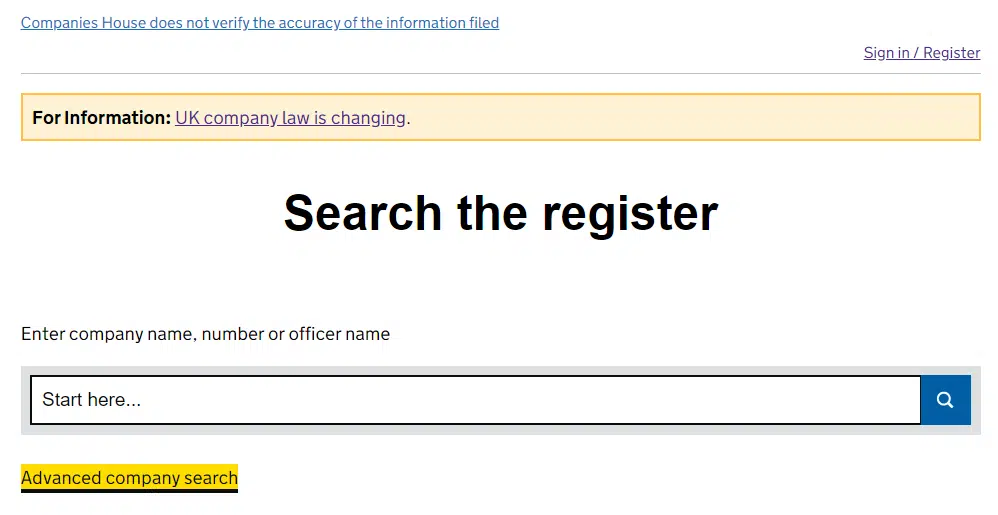
Begin Your Search with a Name, Number, or Director
Visit the Companies House website at find-and-update.company-information.service.gov.uk. Conduct a basic search for any UK company using one of three methods:
- By company name: Enter the full or partial name. If you are forming a new business, use this to verify your chosen name is not already taken or too similar to an existing one. The Companies House search algorithm returns thousands of results for common names like ‘Smith Ltd’, so adding a location is necessary to narrow the list.
- By registration number: Use the unique 8-digit company registration number to find the most direct result. Every UK company receives a registration number at incorporation, and it appears on all official correspondence and filings. Before entering a business relationship, use the number to confirm the company exists and is active.
- By director name: Find every current and past business appointment linked to a specific director. A director name search reveals if an individual has been associated with dissolved or struck-off businesses, which is useful for due diligence.
When a Basic Search Is Too Broad, Use Advanced Filters to Refine It
Click on “Advanced company search” to access options for more targeted results. Provide additional information beyond a name or number to focus your search.
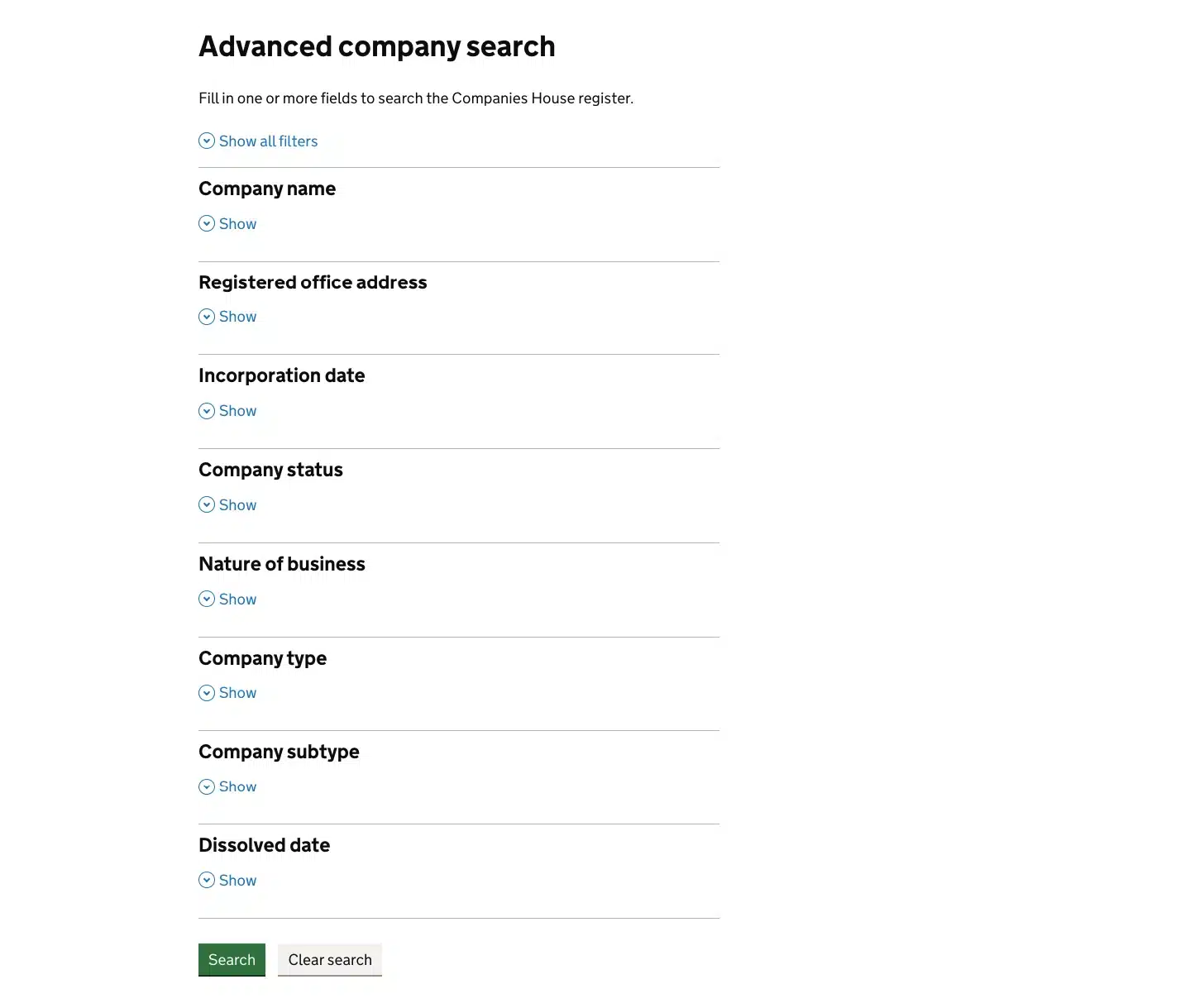
- Specify words that must appear in the registered name or exclude terms you do not want to see.
- Narrow your search by city, region, or postcode if you know the company’s approximate location.
- Set a date range to view company formation dates and identify trends over time, such as the number of tech start-ups formed within a specific year.
- Filter results based on whether a company is active, dissolved, in administration, or undergoing insolvency, to perform due diligence on a director’s history or find viable business partners.
- Use SIC codes to build targeted lists of companies within a specific industry.
- Limit results to certain business structures, such as limited companies or limited liability partnerships.
- Apply filters for subcategories within those company structures.
- Search for companies that were closed within a specific timeframe.
To find active tech companies incorporated in Manchester since the start of 2020, combine these filters: enter ‘tech’ (name), ‘Manchester’ (location), from (date), and ‘active’ (status).
The advanced search displays up to 10,000 records at once. Export up to 5,000 records to a CSV file for analysis. The download includes details such as addresses, SIC codes, and registration dates, making it easy to conduct comparisons or share with your team.
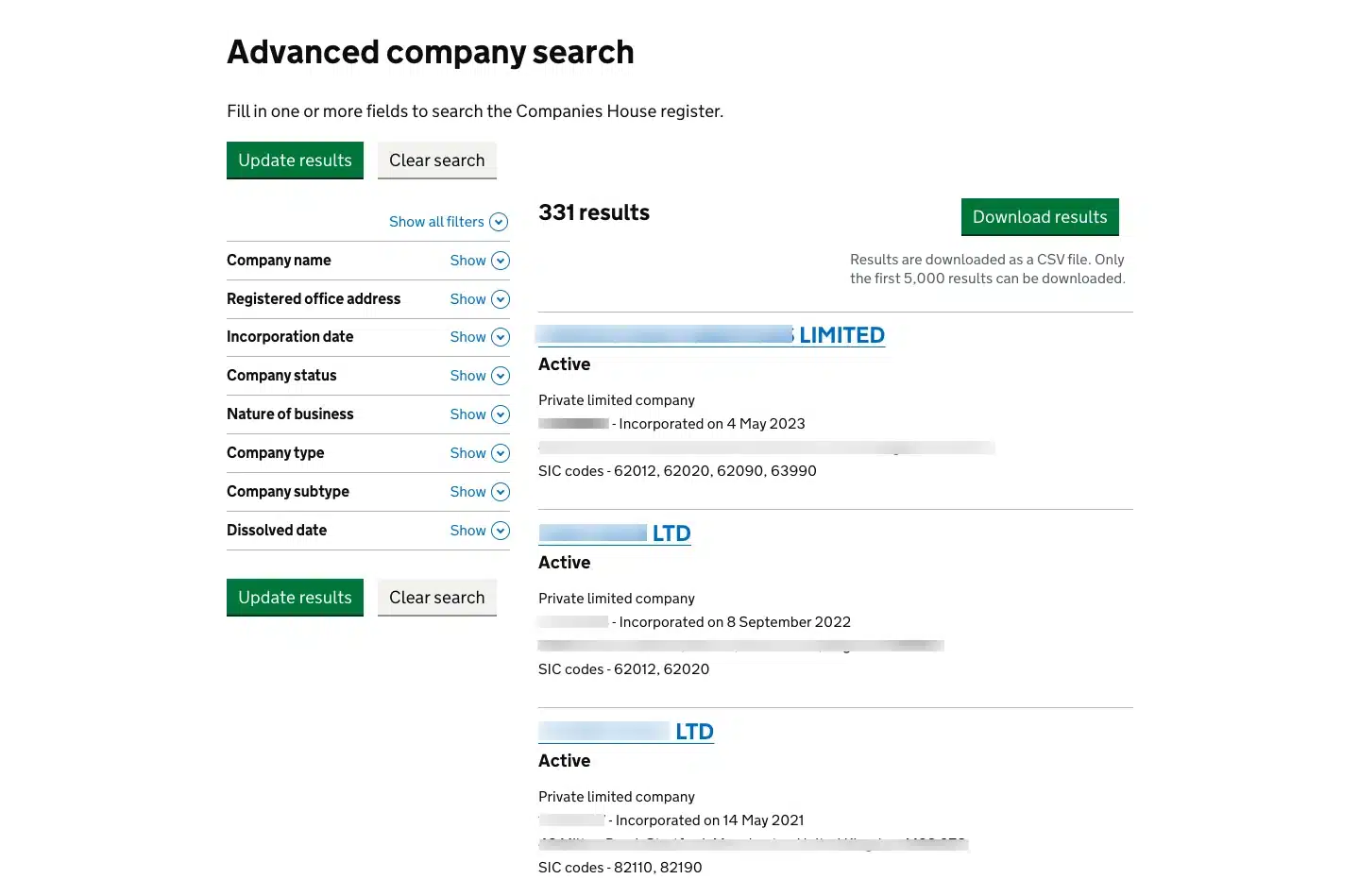
How to Verify Company Details Using 4 Key Sections In the Results
After finding a business of interest in your search results, click its name to view detailed company information, including its overview, filing history, people (company officials) and order certified copies of select company records. The registrar promotes corporate transparency by making this information publicly accessible under the Companies Act 2006.
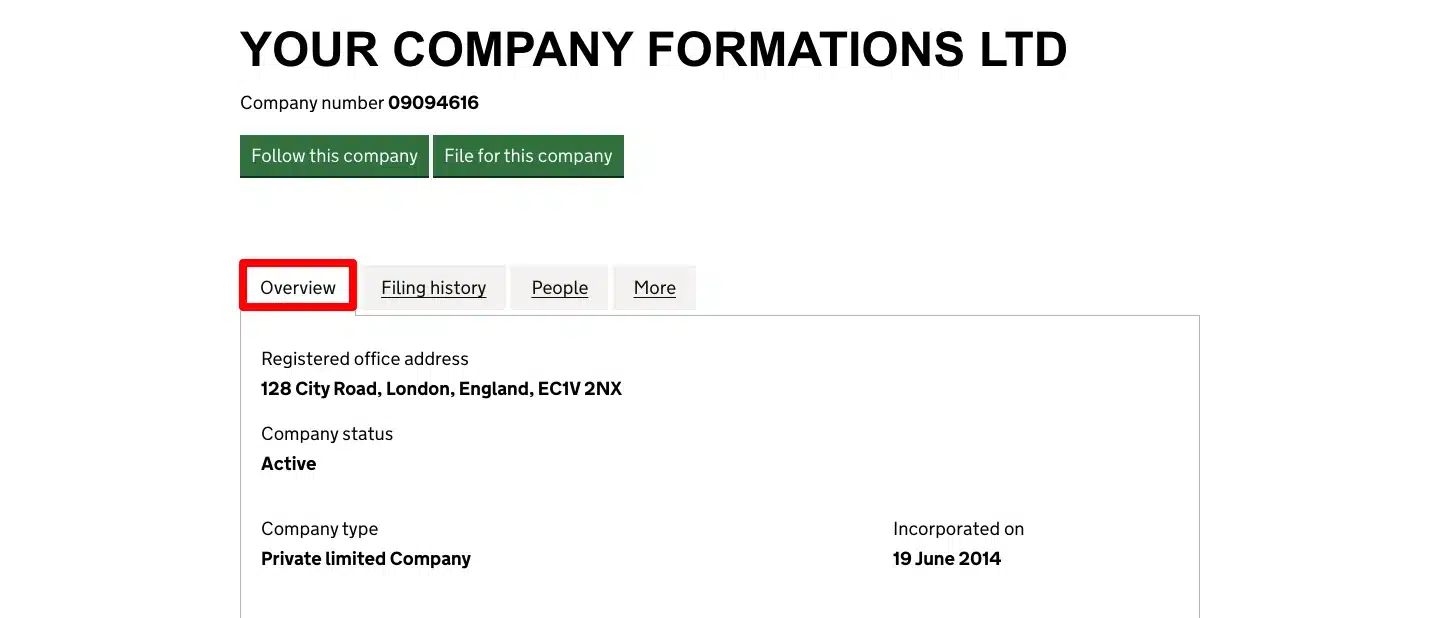
Company Overview: Confirm Status and Business Type
The overview provides key details, including the registration number, date of formation, current status, and business type. As you prepare to register your company, review an existing company in your industry to understand what information becomes public after incorporation.
Filing History: Download Annual Accounts and Statements
Filing History provides a chronological list of filed documents, with downloadable PDFs available from 2003 onwards. Filed documents include financial information such as company accounts (annual accounts), confirmation statements, and any registered charge, including mortgages and securities held against the business.
Annual accounts show the financial health of the business at its year end. They include the balance sheet, profit and loss statement, and notes on any significant liabilities. For small companies, these are often abbreviated, but they still confirm whether the business is solvent and trading actively.
Confirmation statements documents the most recently confirmed details on record, including the registered office address, director names, shareholder information, and share capital. Companies House considers a company non-compliant if its confirmation statement is overdue.
Charge records reveal secured debt, which directly affects a company’s financial standing.
Incorporation establishes a brand-new public record on the registry, triggering immediate, recurring filing duties for the business. A newly formed company must submit its initial confirmation statement within 14 days of its registration anniversary date. Annual accounts follow a separate timeline and require official submission within 9 months of the financial year-end.
People: Identify Directors and Individuals with Significant Control
In the People section, verify officer appointments and resignations, review shareholder details, and identify people with significant control. The register also displays the company’s registered office address in this section.
More: Order Certified Documents and Certificates
The ‘More’ tab offers supplementary services, such as ordering certified copies of documents and official company certificates.
The Register Shows What Was Filed, Not What Is True
The Companies House register reflects submitted filings, not real-time business activity. Accounts can be up to 21 months old by the time they appear on the public register, owing to the standard 9-month filing deadline granted following the end of a 12-month accounting period. A balance sheet filed at the deadline describes a company’s financial position exactly as it stood nearly two years prior. Assessing an entity’s financial health before entering a binding contract or corporate partnership requires accounting for this built-in filing delay.
Company status on the register does not confirm whether a business is actively trading. A company listed as “active” may be dormant in practice, operating with no revenue, no employees, and no ongoing trade. The registry database only updates an entity’s status to “dissolved” or “in liquidation” after a formal legal process concludes. Until then, inactive companies display an identical status to actively trading businesses. However, for businesses in administration or insolvency, the register will reflect the most recently filed status.
Pending filings do not appear on the public register until Companies House completes internal processing. A change of director, a new registered office address, or a share allotment may be submitted by corporate officers but remain unrecorded for days. Processing times routinely extend beyond standard government timeframes during high-volume filing periods. Verifying a company’s current officers or address details requires direct confirmation from the business to avoid reliance on outdated public records.
Person with significant control (PSC) information depends entirely on self-reporting. Companies face a statutory requirement to identify and declare anyone holding more than 25% of shares or voting rights, yet the registrar cannot independently verify these declarations. Corporate changes in ownership that go unreported leave the public record permanently outdated until the business files an annual confirmation statement or faces direct enforcement action.
Set Up Free Email Alerts for Company Changes
Companies House offers a free Follow service that sends email alerts whenever a business you track accepts a new filing. The alert arrives instantly and includes a link to the filing history, allowing you to download the relevant document for free.
To activate alerts, find the business on the register and open its overview page. Click “Follow this company” to begin receiving notifications. To stop alerts for a specific business, click “Unfollow” on the same page. Follow as many businesses as you need, and the service is entirely free
Prepare for Upcoming Identity and Filing Rule Changes
Starting on , the Economic Crime and Corporate Transparency Act, reforms overseen by the Department for Business and Trade, makes identity verification a legal requirement for all new directors. Existing directors must verify their identity via GOV.UK One Login by .
How to Protect Personal Information on the Public Register
Companies House cannot remove certain legally required details, such as director names, from the public register. Under the Companies Act, this information must remain publicly accessible.
Apply for address suppression if you have personal safety concerns. Upon approval, the public register will display a director service address instead of your residential address. To apply, contact Companies House directly and follow its guidance on protecting personal data.

Your email address will not be published. Required fields are marked *