
- Following Labour’s July 2024 election victory, employment law reform continued through the Employment Rights Act 2025. Some measures took effect in April 2026, with further changes scheduled across October 2026 and 2027.
- Other Employment Rights Act 2025 reforms include stronger workplace harassment protections from October 2026, a six-month qualifying period for ordinary unfair dismissal from January 2027, and guaranteed-hours and further flexible-working reforms during 2027.
- Several 2024 employment law reforms, including day-one flexible working requests and extended redundancy protection for pregnant employees, were introduced under the Conservative government. Labour has since built on these measures through the Employment Rights Act 2025, with further reforms being implemented across 2026 and 2027.
UK Employment Law Changes Effective October 2024
General elections often serve as a referendum on crucial national issues, providing the winning party with a mandate to implement reforms in line with their manifesto.
Following the Labour Government’s victory in July 2024, several employment law changes took effect that October, while the new government began progressing wider employment-rights reforms. Those wider reforms later became the Employment Rights Act 2025 and are being implemented in stages through 2026 and 2027.
Shared Priority Across Political Spectrum
Several reforms highlighted in this article were introduced under the previous Conservative government led by Rishi Sunak. Labour has since built on these earlier initiatives through the Employment Rights Act 2025, which introduces further employment protections in stages across 2026 and 2027.
The page covers employment law changes that took effect in 2024 and wider reforms that later became the Employment Rights Act 2025:
- Employment (Allocation of Tips) Act 2023 (Effective October 2024): This Act requires employers to pass qualifying tips, gratuities and service charges on to workers without deductions, except in limited circumstances such as income tax.
- Worker Protection (Amendment of Equality Act 2010) (Effective 26 October 2024): The amendment legally obliges all UK employers to take reasonable steps to prevent sexual harassment in the workplace.
- Employment Rights Act 2025 (introduced as the Employment Rights Bill on 10 October 2024): The Bill received Royal Assent on 18 December 2025. The Act introduces phased reforms including stronger workplace harassment protections from October 2026, a six-month qualifying period for ordinary unfair dismissal from January 2027, and guaranteed-hours and further flexible-working reforms during 2027.
These reforms represent a significant shift in employment law, reflecting the Labour Government’s drive to modernise the workplace and provide stronger protections for employees across the UK.
Employment Rights Act 2025: Key Reforms
The UK government introduced a range of employment law reforms through the Employment Rights Bill, which received Royal Assent on 18 December 2025 and became the Employment Rights Act 2025. According to the party, employment laws have struggled to keep up with the changing nature of work and the growing need to support a better work-life balance.
The following sections explain three major reforms originally proposed in the Bill and their current position under the Employment Rights Act 2025:
1. Unfair Dismissal Qualifying Period
The Bill originally proposed making ordinary unfair dismissal protection a day-one right. Parliament replaced this proposal during the Bill’s final stages, and the Employment Rights Act 2025 will instead reduce the qualifying period from two years to six months for dismissals from 1 January 2027. Existing protections against automatically unfair dismissal continue to apply without this qualifying period.
Day One Rights Protection
Some Employment Rights Act 2025 measures now provide day-one rights, including Paternity Leave and Unpaid Parental Leave from 6 April 2026. Statutory Sick Pay also became payable from the first qualifying day of sickness from that date. Ordinary unfair dismissal protection is different: its qualifying period will fall to six months from 1 January 2027.
2. Zero hour contracts
In the UK, employers can offer zero-hour contracts, where employees have no guaranteed minimum working hours. This arrangement is commonly used in industries with fluctuating demand, such as retail and hospitality. Under the Employment Rights Act 2025, employers will be required to offer eligible zero-hours and low-hours workers guaranteed hours reflecting the hours they regularly work over a reference period. Workers will be able to reject the offer and remain on their existing arrangement. The reference period and other detailed eligibility rules will be set in regulations.
3. Statutory sick pay
From 6 April 2026, Statutory Sick Pay (SSP) became payable from the first qualifying day of sickness, and the Lower Earnings Limit was removed. Eligible employees are now paid the lower of the standard weekly SSP rate, currently £123.25, or 80% of their average weekly earnings.
Labour’s Broader Commitment
Labour’s wider employment agenda also includes measures outside the Employment Rights Act 2025. In March 2026, the Government confirmed plans to introduce mandatory ethnicity and disability pay gap reporting for employers with 250 or more employees through separate legislation. The Employment Rights Act 2025 does not create a statutory right to disconnect, and this proposal is not included in the Government’s current Act implementation timetable.
Where the Bill Stands Now: Employment Rights Act 2025 Implementation Timeline
Since publication, the Bill has completed its passage through Parliament. It received Royal Assent on 18 December 2025 and is now the Employment Rights Act 2025.
Rather than a single start date, the reforms arrive in stages under the Government’s implementation roadmap: day-one paternity and unpaid parental leave plus statutory sick pay reform came in from April 2026, new tribunal time limits and harassment duties follow in October 2026, and from January 2027 the qualifying period for unfair dismissal claims falls to six months.
Parliament replaced the originally proposed day-one right during the Bill’s final stages. The guaranteed-hours rules for zero-hours workers are due later in 2027, giving employers time to review contracts and update policies.
Pro-active Duty to Prevent Sexual Harassment at Work (Effective 26th October 2024)
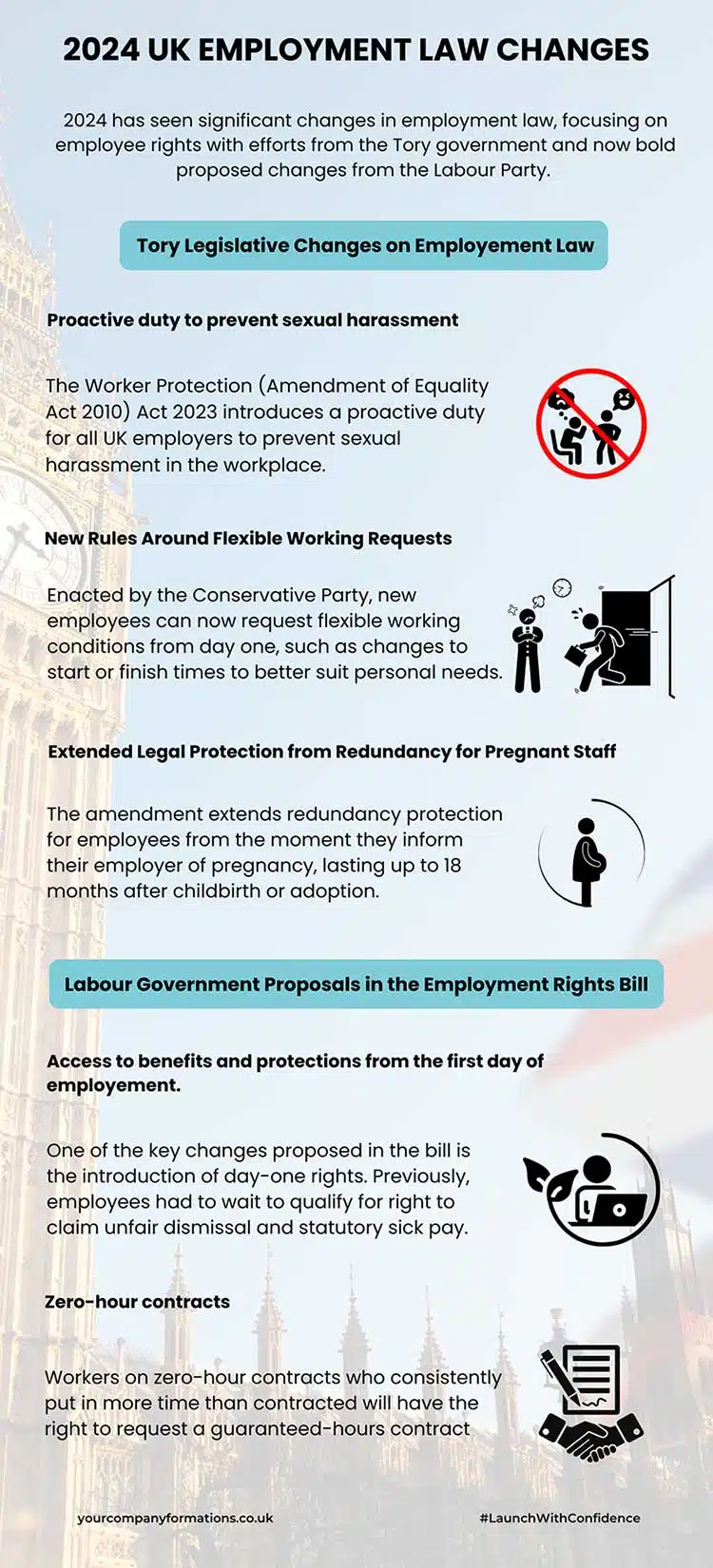
Introduced under the Conservative government, the Worker Protection (Amendment of Equality Act 2010) Act 2023 created a proactive duty for UK employers to take reasonable steps to prevent sexual harassment at work. The duty took effect on 26 October 2024. This duty applies to all employers, regardless of size or sector, and extends beyond workplace harassment by colleagues to include third-party harassment from customers, clients, and visitors.
Employers must take reasonable steps to prevent sexual harassment. EHRC guidance explains that these steps can include assessing risks, maintaining an effective anti-harassment policy and providing clear procedures for reporting and responding to complaints. The law does not prescribe the same specific steps for every employer.
The Equality and Human Rights Commission (EHRC) has been granted enforcement powers, enabling it to investigate employers for compliance. If a breach is identified, the EHRC can find that an organisation has committed an unlawful act and issue a notice to confirm its findings. The organisation will then be required to prepare an action plan to address and prevent future breaches.
EHRC can also enter into a legally binding agreement with the employer to prevent further violations or seek a court injunction to stop the employer’s unlawful actions.
Flexible Working Request Rules (Effective April 2024)
Introduced under the Conservative government, the April 2024 changes gave employees the right to request flexible working from their first day of employment, removing the previous 26-week qualifying period. Employees can make up to two statutory flexible working requests in any 12-month period. The reforms also removed the requirement for employees to explain what effect their requested change would have on the employer. Employers must normally decide a request within two months, although a longer decision period can be agreed with the employee.
Statutory Code of Practice on “Fire and Rehire”
Commonly referred to as dismissal and re-engagement, “fire and rehire” is a controversial practice in which employers terminate employees and rehire them under new terms that are often more favourable to the employer. The Statutory Code of Practice on Dismissal and Re-engagement came into force on 18 July 2024 and sets out employers’ responsibilities when seeking to change contractual terms and conditions.
The Code builds on existing legal obligations, such as the requirement for collective redundancy consultations when the number of affected employees meets the threshold. It stresses that “fire and rehire” should only be used as a last resort after exploring all other options.
The Code emphasises the importance of clear communication and transparency during changing terms and conditions. Employers are encouraged to engage with employees or their representatives as early as possible, provide detailed information, and consult adequately to explore alternative solutions before resorting to dismissal and re-engagement.
Employment Rights Act 2025 Fire and Rehire Changes
The Employment Rights Act 2025 introduces stronger protections against fire and rehire. From January 2027, dismissals in specified circumstances involving contract changes or replacement on substantially altered terms will become automatically unfair, subject to the statutory exceptions.
Extended Legal Protection from Redundancy for Pregnant Staff (Effective April 2024)
The 2024 changes extended the period during which certain employees have priority for a suitable alternative vacancy if they are selected for redundancy. For pregnancy and maternity, the protected period starts when the employee tells their employer they are pregnant and normally ends 18 months after the birth.
Adoption leave is protected until 18 months after placement, while the end date for Shared Parental Leave depends on the length and pattern of leave taken. Previously, redundancy protections primarily applied to those on maternity leave, excluding individuals on shared parental or adoption leave. This extension ensures broader security for all new parents, reflecting a more inclusive approach to family rights in the workplace.
New Law Provides More Flexibility for Paternity Leave
The April 2024 changes allow eligible employees to take up to two weeks of Paternity Leave either together or as two separate one-week blocks. For births, the leave must end within 52 weeks of the baby’s birth, or the due date if the baby is early; different timing rules apply to adoption.
For a birth, employees must normally tell their employer the baby’s due date at least 15 weeks before the expected week of birth and give at least 28 days’ notice of when they want their Paternity Leave to start and how much leave they want to take.
Carer’s Leave Act 2023
The Carer’s Leave Act 2023 came into force on 6 April 2024. Since then, eligible employees caring for a dependant with a long-term care need have had a statutory right to one week of unpaid Carer’s Leave each year.
Infographic 2024 Employment Law Changes

Excellent article! It was worth noting these employment law changes for my own accounting solutions business.