- A GB EORI is used for customs movements to or from Great Britain, while an XI EORI applies to certain Northern Ireland customs activities.
- You do not need an XI EORI if you already have an EORI issued by an EU country.
- You can check whether a GB EORI is valid using GOV.UK before applying for a new one.
- Most applicants receive a GB EORI immediately, although HMRC checks can take up to five working days.
What is an EORI number?
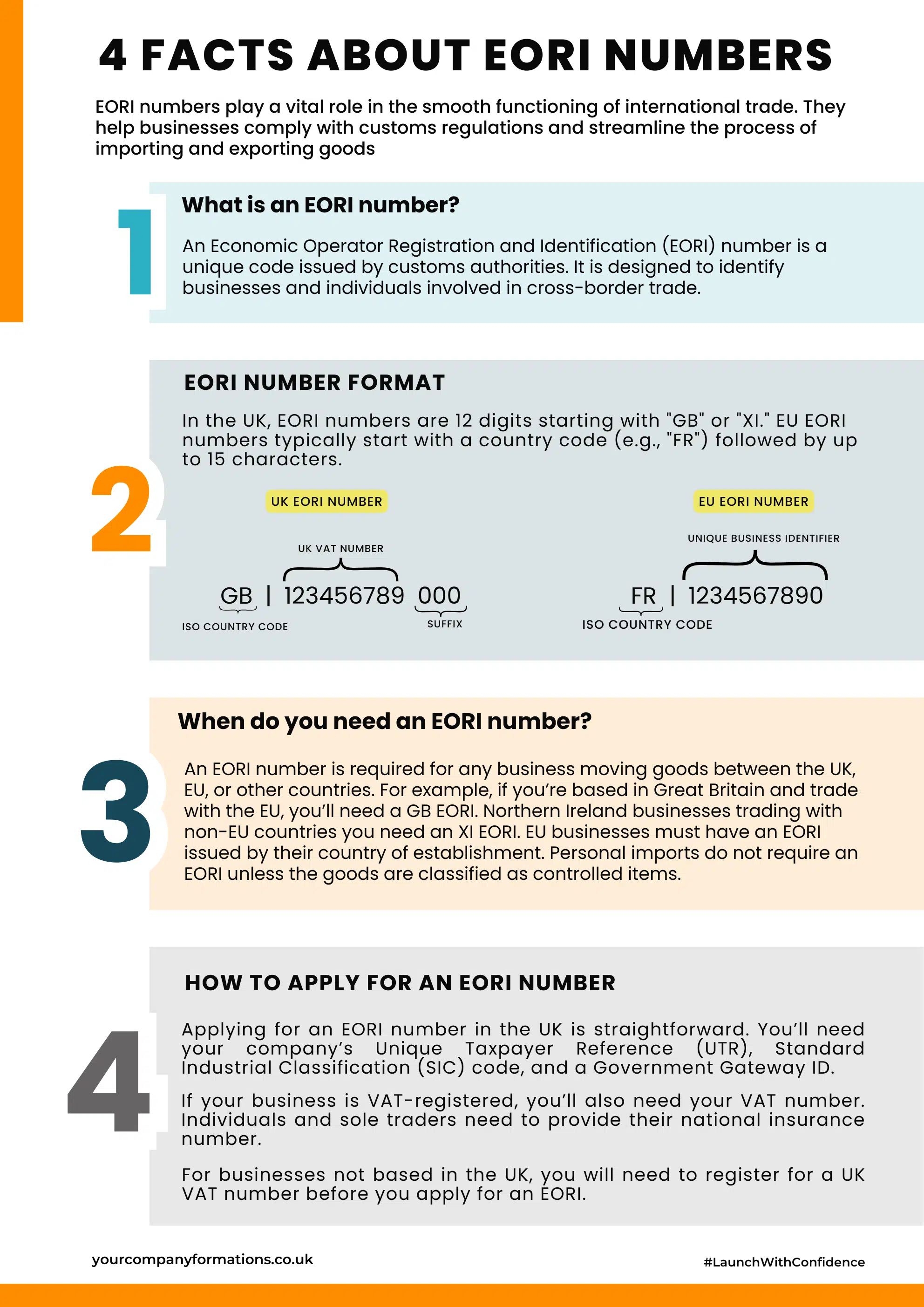
EORI stands for Economic Operators Registration and Identification. It is a unique identifier used by customs authorities to identify businesses and other persons carrying out activities covered by customs legislation. GB and XI EORI numbers are issued by HMRC, while EU EORI numbers are issued by customs authorities in EU member states.
In the UK, the EORI reference is typically 12 digits long and starts with “GB” for Great Britain or “XI” for Northern Ireland. For example, GB123456789000, where “GB” is the country code and “123456789000” is the unique identifier.
The format may vary for other EU countries. For instance, in the Netherlands, an EORI code starts with “NL” followed by 9 digits, such as NL123456789.
What Are The Types of EORI Numbers?
There are three EORI formats most relevant to UK and EU trade: GB EORI numbers, XI EORI numbers for certain Northern Ireland customs activities, and EORI numbers issued by EU member states. An EU EORI uses the issuing member state’s prefix and is valid for customs operations across the EU.
After Brexit, the UK introduced its national customs procedures and a distinct EORI code format starting with “GB,” followed by the business’s VAT registration number and “000” (e.g., GB123456789000). Businesses not registered for the tax use “GB,” followed by a unique number issued by HMRC.
How Do I Know If I Need a GB, XI or EU EORI Number?
Whether you need an EORI number depends on where your goods move and the customs activity involved. You need an EORI number if you move goods between:
- Great Britain (England, Scotland, and Wales), the Isle of Man, and any other country (including the EU).
- GB and Northern Ireland
- GB and the Channel Islands
- Northern Ireland and countries outside the EU
An EU-established business needs an EU EORI when it carries out customs operations such as importing, exporting or transit. An EU EORI is not required merely because Union goods move between EU member states.
If you move goods to or from Northern Ireland, you may need an XI EORI. If your business is established in an EU country, you must use an EU EORI for customs movements to and from Northern Ireland.
Personal Use Exemption
You do not need an EORI number if the goods are both for personal use only and not controlled goods.
How to Determine Which EORI Number You Need?
The EORI number you need depends on where your business is established, where the goods are moving, and the customs activity involved. For movements to or from Great Britain, you need a GB EORI. For Northern Ireland, you may need an XI EORI, while EU-established businesses use an EU EORI for Northern Ireland customs movements.
You do not normally obtain an EORI from every country you trade with. For customs declarations or decisions in the EU, you need an EU EORI, or an XI EORI if you have a permanent business establishment in Northern Ireland and meet the relevant conditions.
Fundamental principles to help you determine which EORI reference you need —
- Single EORI principle: A company only needs one EORI for the entire EU (typically the country where your business is established or where it first conducts customs-related activities), even with multiple value-added tax numbers across different EU countries.
- GB EORI for UK trade: You’ll need an EORI number that starts with “GB” if you’re moving goods to or from Great Britain.
- XI EORI: UK Businesses that move goods to or from Northern Ireland might need an EORI number that starts with “XI.” Before applying for a Northern Ireland XI EORI number, you must first obtain a Great Britain EORI reference.
- EU exporter EORI: An exporter established in the EU uses the EORI issued by the member state where it is established.
- EU importer EORI: An importer established in the EU uses the EORI issued by the member state where it is established.
- Non-EU businesses: Companies established outside the EU but trading with EU countries may need to obtain an EORI number from the EU country where they first lodge a customs declaration or apply for a decision.
If your business is based in the Channel Islands and moves goods to or from the UK, you do not need an EORI number solely for that movement. However, you need an EORI number if you use HMRC customs systems such as the Customs Declaration Service or Import Control System 2, apply for a customs decision, or register for an export licence.
EORI Number Scenarios
Understanding EORI numbers is crucial for smooth customs operations in international trade. Here’s a practical example of how these numbers are used:
Scenario 1: Bringing Goods from France to the UK
Imagine you run a UK-based business importing French wines. As these wines are shipped from France, your French supplier uses their EORI number, starting with “FR,” for the export declaration in France. When the goods arrive in the UK, you will use your UK EORI number, starting with “GB,” to handle the customs clearance and ensure that all duties and VAT are correctly processed.
Scenario 2: Moving Goods from France to Italy
Consider a French business moving Union goods from France to Italy. Because both countries are in the EU customs union, an EORI is not required solely for an ordinary intra-EU movement of those goods. The French EORI remains valid throughout the EU for customs operations where an EORI is required.
A business is considered established in a particular jurisdiction if it has one or more of the following:
- A registered office
- A central headquarters
- A permanent business establishment includes premises where customs-related activities are conducted and where HR and technical resources are consistently based.
How to Get an EORI Number in the UK
To get a GB EORI number, complete the online application through HMRC using the GOV.UK EORI service. Here are the steps:
- Go to the GOV.UK EORI application service: Start the online application for a GB EORI number through HMRC.
- Sign in with your Government Gateway details: Use your Government Gateway ID and password to access the application.
- Enter your business information: Provide the requested details about your business, including your UTR, business start date, SIC code and VAT information where applicable.
- Submit your EORI application: Check that your details are correct and submit the application to HMRC.
- Receive your EORI number: Most applicants receive their EORI number immediately. If HMRC needs to carry out additional checks, the application can take up to five working days.
To apply for a GB EORI on GOV.UK, you will need:
- Your company UTR number
- Your business start date
- Standard Industrial Classification (SIC) code, as provided by Companies House.
- VAT Number and the effective date of registration, if registered
- National Insurance Number, if you’re an individual or sole trader
- Your Government Gateway ID and password
If your business is part of a VAT group, use this EORI number application form instead.
VAT Group EORI Rules
If your company is in a VAT group, it is treated as a separate legal entity for EORI purposes. A VAT-group member that imports or exports commercial goods needs its own EORI, although another VAT-group member with an EORI can make declarations on its behalf and becomes responsible for the related customs obligations.
How Do I Check If I Already Have a GB EORI Number?
To find out if you already have a British EORI, follow these steps:
- Visit the “check EORI number page” at https://www.gov.uk/check-eori-number
- Enter the number you think could be your EORI number. Use this system to check numbers that start with “GB.” If uncertain, enter your VAT number with “GB” at the beginning and “000” at the end. For example, if your number is 123456789, you would enter GB123456789000.
- Click “Continue” to submit your query.
- The system will inform you if the number you provided is valid as an EORI.
Do I need a GB EORI number to Move Goods to or From Northern Ireland?
You do not automatically need both a GB and XI EORI for every movement involving Northern Ireland. You need a GB EORI for movements to or from Great Britain, while an XI EORI may be needed for Northern Ireland customs activities. If you already have an EU EORI, you do not need an XI EORI.
HMRC Regulation Update
In September 2024, HMRC updated its guidance for EIDR movements from Great Britain to Northern Ireland. Businesses with an XI EORI linked to a valid EIDR authorisation should use that XI EORI to generate the Goods Movement Reference (GMR) for those EIDR movements.
If you do not make EIDR movements between Great Britain and Northern Ireland using GVMS, this specific change does not apply. If you use the Trader Support Service for an EIDR movement, TSS provides the EORI number that holds the authorisation for use in the GMR. If someone creates the GMR on your behalf, give them the relevant EORI linked to the EIDR authorisation.
XI EORI and the UK Internal Market Scheme (UKIMS)
An XI EORI also works alongside the UK Internal Market Scheme (UKIMS), which replaced the UK Trader Scheme in September 2023. Once authorised, UKIMS lets you declare goods moving from Great Britain to Northern Ireland as “not at risk” of onward movement into the EU, so no EU duty is charged. You can apply for UKIMS using your XI EORI if you hold one, or your GB EORI if you are not entitled to an XI EORI. For UKIMS declarations, use the GB or XI EORI linked to the authorisation; HMRC checks the scheme’s eligibility conditions before approving an application.
Must I Have an HMRC VAT Number to Apply For an EORI Number?
You can apply for an EORI number even if you are not VAT registered. HMRC generates a GB EORI with a unique 12-digit number for a non-VAT-registered business. If you are VAT registered, the first nine digits of your GB EORI match your VAT number; VAT-group members can have different suffixes.
If a non-VAT-registered business later becomes VAT registered, its previous EORI is cancelled and must be replaced with one that reflects the new VAT number.
4 Facts About EORI Numbers

Your email address will not be published. Required fields are marked *