
- A CRN number is a unique identifier issued by Companies House when you incorporate a business. It can be an 8-digit number or a combination of letters and digits, varying by location and type of company.
- The number appears on your certificate of incorporation and statutory mail. Legally, it must be shown on your business letters, order forms and websites, together with your registered office address, where the company is registered and the fact that it is a limited company.
- Use your registration number for official tasks such as communicating with Companies House, filing your confirmation statement, changing company details, and managing taxes. Avoid confusing it with other numbers like your VAT or Unique Taxpayer Reference (UTR).
What Is a Company Registration Number?
A Company Registration Number (CRN), also known as a “Companies House Number” or “Company Number,” is a unique identifier assigned to limited companies, LLPs and limited partnerships when they are registered with Companies House. While company names can share similar words or phrases with other businesses, the CRN is unique and valid for the life of the company, and no two companies will have the same number.
Find out more: GOV.UK One Login Programme Explained!
What is the format of a Company Registration Number?
A CRN is a unique identifier for UK companies. It is typically 8 characters long: 8 digits or 2 letters followed by 6 digits.
- Eight digits (e.g., 12345678)
- Two letters followed by six digits (e.g., AB123456)
However, the exact format can vary depending on the location and type of company:
- 8-digit number: Companies formed in England and Wales
- “OC” prefix: LLPs in England and Wales
- “LP” prefix: Limited Partnerships in England and Wales
- “SC” prefix: Companies formed in Scotland
- “SO” prefix: Scottish Limited Liability Partnerships (LLPs)
- “SL” prefix: Scottish Limited Partnerships
- “NI” prefix: LTDs in Northern Ireland
Do sole traders and partnerships need a company registration number?
Sole traders do not receive CRNs because they register with HMRC rather than Companies House. Similarly, general partnerships, also known as ordinary partnerships, do not have a business identification number as the registrar of companies does not incorporate them. Only bodies incorporated or registered at Companies House, limited companies, LLPs, and limited partnerships, are given a registration number.
See also: Guide to Public Limited Companies (PLC)
How Do I Find A Company Registration Number?
There are a few places where you can locate your CRN:
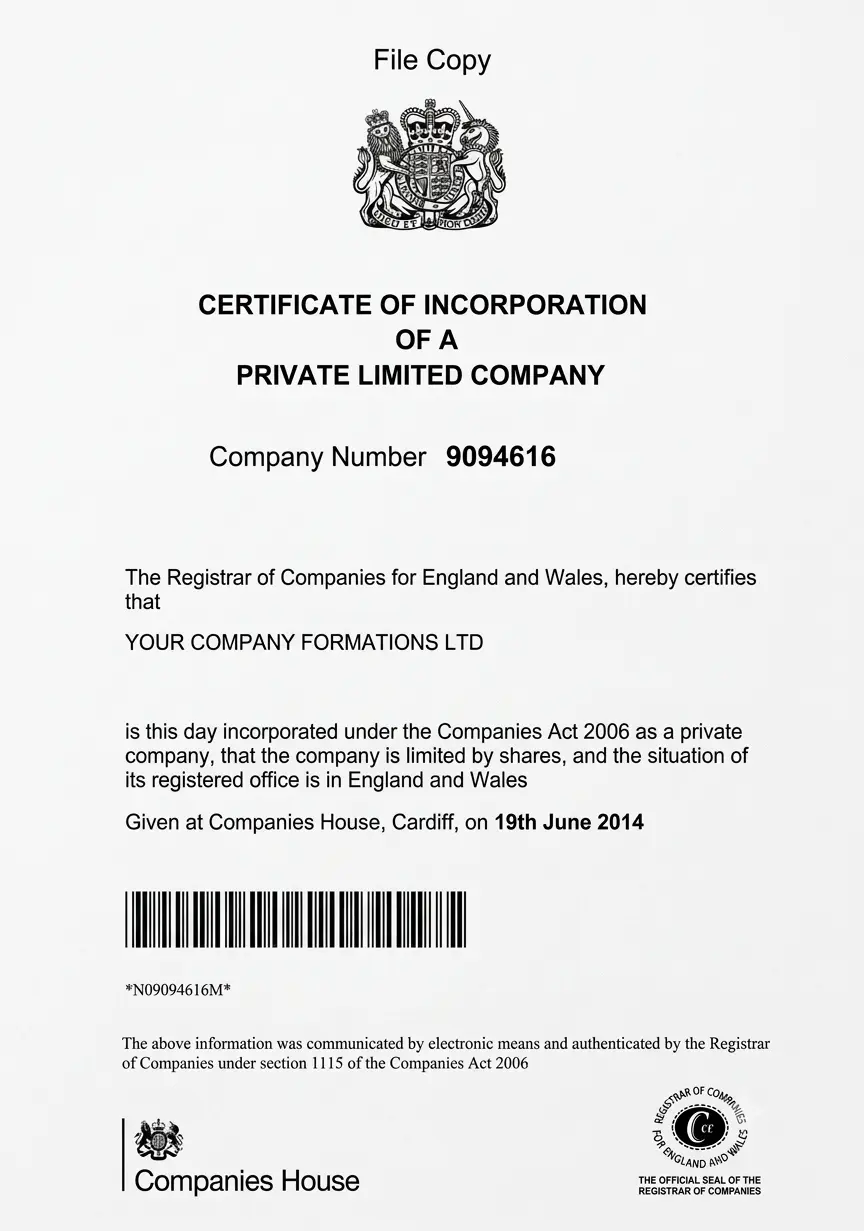
- Certificate of incorporation: Once you set up a limited company, you will find your CRN in the registration certificate.
- Companies House correspondence: Look for your CRN on any official mail from Companies House. It’s usually printed alongside or beneath headings like “Company No.”
- Correspondence from advisors: Communications from advisors, such as your company formation agent or accountant, may also include your CRN.
- Online public register: You can find your company identification number through the Companies House Search service by following the steps below.
Step 1: Visit https://find-and-update.company-information.service.gov.uk/
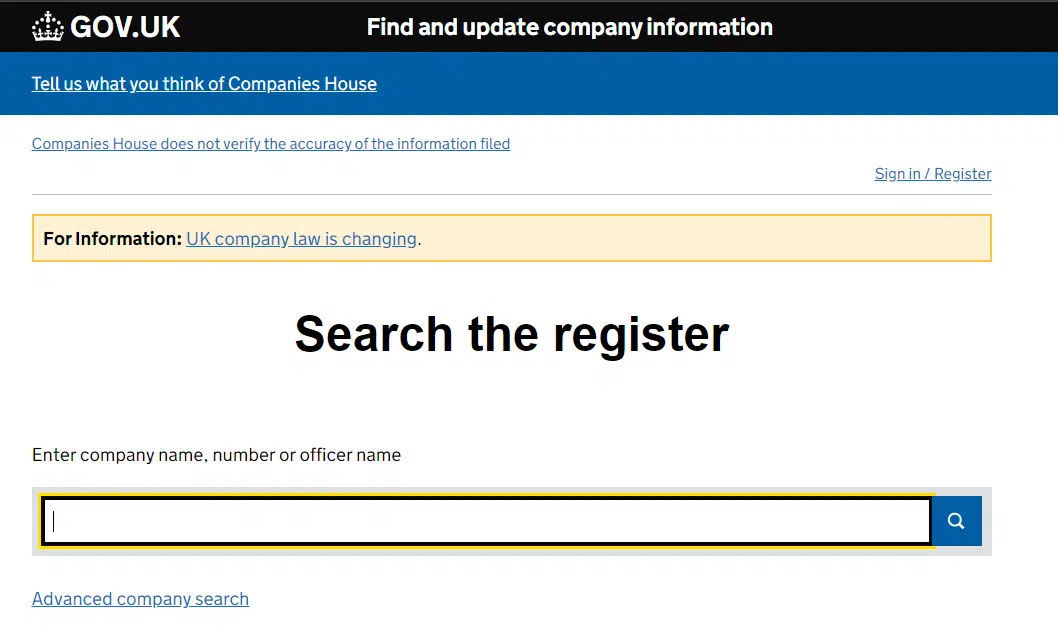
Step 2: To search for a company, enter its name in the search box.
Step 3: Click the “SEARCH” button. You’ll see a list of all UK companies with names that match yours, in part or in full. For instance, if your company is named “GreenTech Solutions,” the search results might include similar names like “GreenTech Innovations,” “GreenTech Services,” or “EcoGreenTech Solutions.” The list will include the registered office addresses to help you identify and select the correct company.
Step 4: Click on the company of interest.
Step 5: The CRN is below the company name and is labelled “Company Number.”
You can run the same lookup without leaving this site: our Free UK Company Check searches any UK company by name or registration number and returns status, registered address, company type, SIC code, incorporation date, directors, persons with significant control, outstanding charges and the last five filings – free, no login.
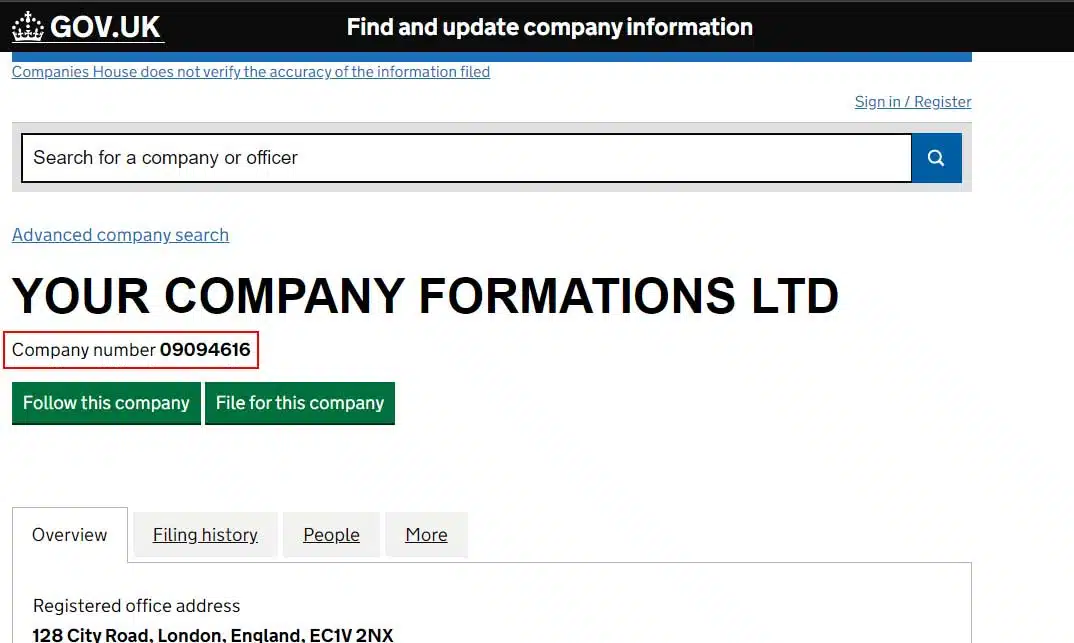
Here is what this looks like using Your Company Formations as an example.
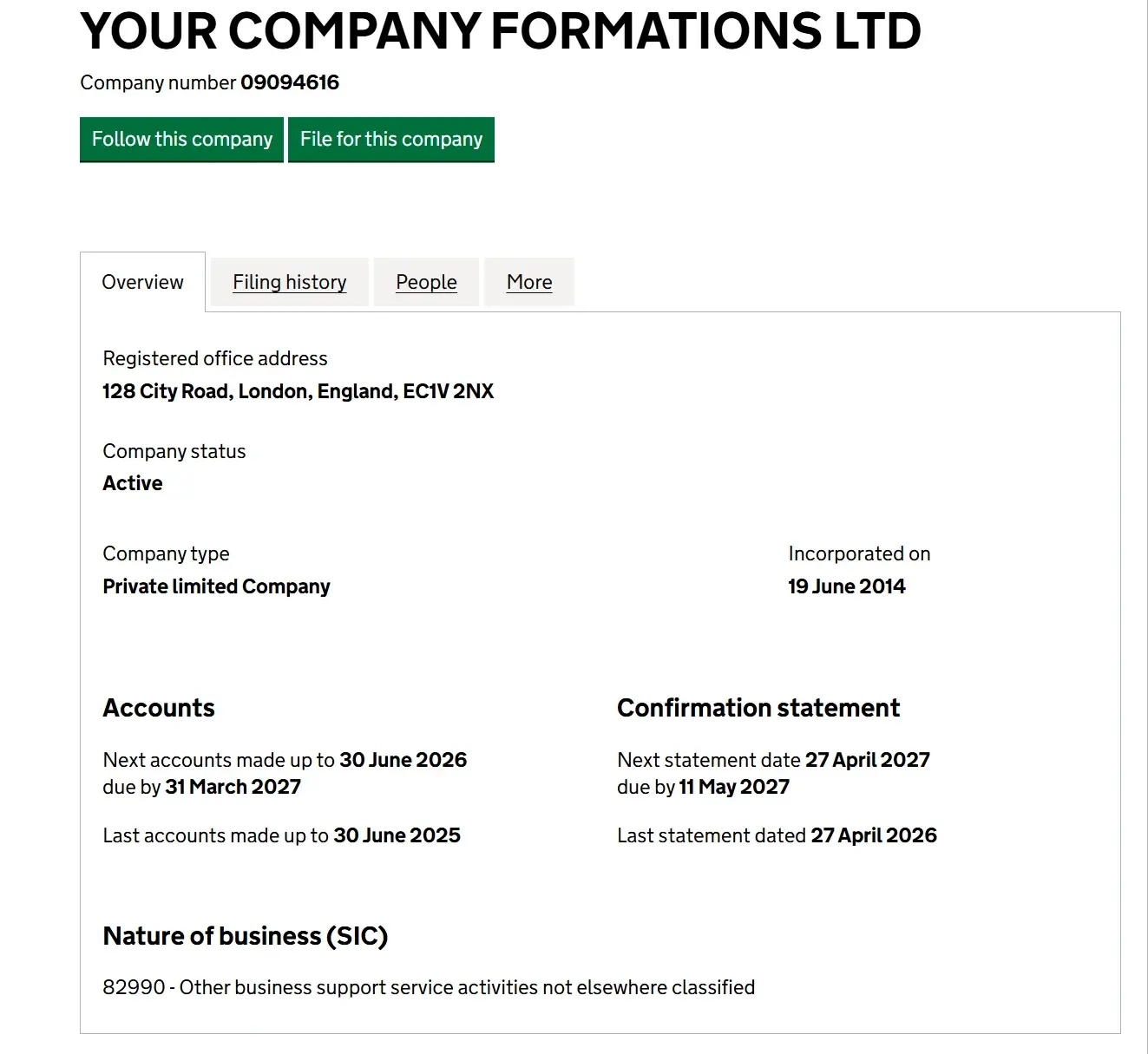
On the Companies House register, the company number appears directly below the company name on the company overview page. For Your Company Formations Ltd, this makes the register a straightforward place to check the number online.
The company number also appears on the Certificate of Incorporation. On our certificate, it is shown near the top of the document under “Company Number”, above the company name.
Where should I display my company registration number?
Your CRN is a crucial element of your business identity. As a limited company, the law requires you to show the number on your business letters, order forms and websites. This helps to ensure transparency and compliance with UK company law.
You should include it in the following official company stationery:
- Letterheads: On all official letters your company sends.
- Emails: A business letter sent by email carries the same details, so put them in your signature.
- Invoices: Not required by law – an invoice must carry your full company name as it appears on the certificate of incorporation – but most limited companies add the number because the same details already sit on their letterhead.
- Receipts: Optional, but consistent with the rest of your paperwork.
- Online Content: The number should be prominently displayed in the footer of your website and on key pages like the “Contact” or “About Us” sections.
- Order Forms: Any order forms your business uses should include the registration number to ensure legal compliance.
Showing the number on letters, order forms, and your website is a legal requirement; everywhere else, it is good practice that makes you easy to check.
Once those invoices are going out, the money has to land somewhere separate from your personal account. Revolut Business is one option, with a £100 welcome bonus for new business customers.
Can I use a CRN to discover the previous company name of a business?
Yes, you can use a company number to determine a business’s previous name. When you search using the CRN, the search results will display only the company associated with that unique registration number. After selecting the company, scroll down the page, and you will find a section that lists any previous names the company has used.
If you have just pulled your company registration number off the register and still do not have a business account in the company’s name, open Revolut Business and claim the £100 welcome bonus.
| Revolut Business | Airwallex | Wise Business | |
|---|---|---|---|
| Best for | Day-to-day UK business banking with multi-currency built in. | Collecting payments in other currencies with local account details. | Paying and getting paid abroad at the real exchange rate. |
| Currencies | Hold, exchange and send in over 30 currencies at the real exchange rate. | Local account details in more than 20 currencies; send in over 60 currencies to more than 200 countries. | Hold and convert multiple currencies, with a debit card that spends abroad. |
| Cards and spending | Physical and virtual cards for your team with spending limits. | Company and employee cards with individual limits. | Wise debit card. |
| Accounting | Syncs with Xero and QuickBooks. | Connects to Xero and QuickBooks. | Integrates with Xero. |
| How your money is protected | Eligible deposits held with Revolut Bank UK are FSCS-protected, up to £120,000 per person per bank. | Not a bank: an electronic money institution, so your money is safeguarded rather than FSCS-protected. | Not a bank: an FCA-authorised electronic money institution, so your money is safeguarded rather than FSCS-protected. |
| Welcome offer through our link | £100 welcome bonus for new business customers who open an account and add money by 31 December 2026. Fees, promotion terms and T&Cs apply. | One month free on an eligible Explore or Grow plan. Eligibility and T&Cs apply. | Not stated. |
| Claim Your £100 Bonus | Open an Airwallex account | Open a Wise Business account |





Your email address will not be published. Required fields are marked *