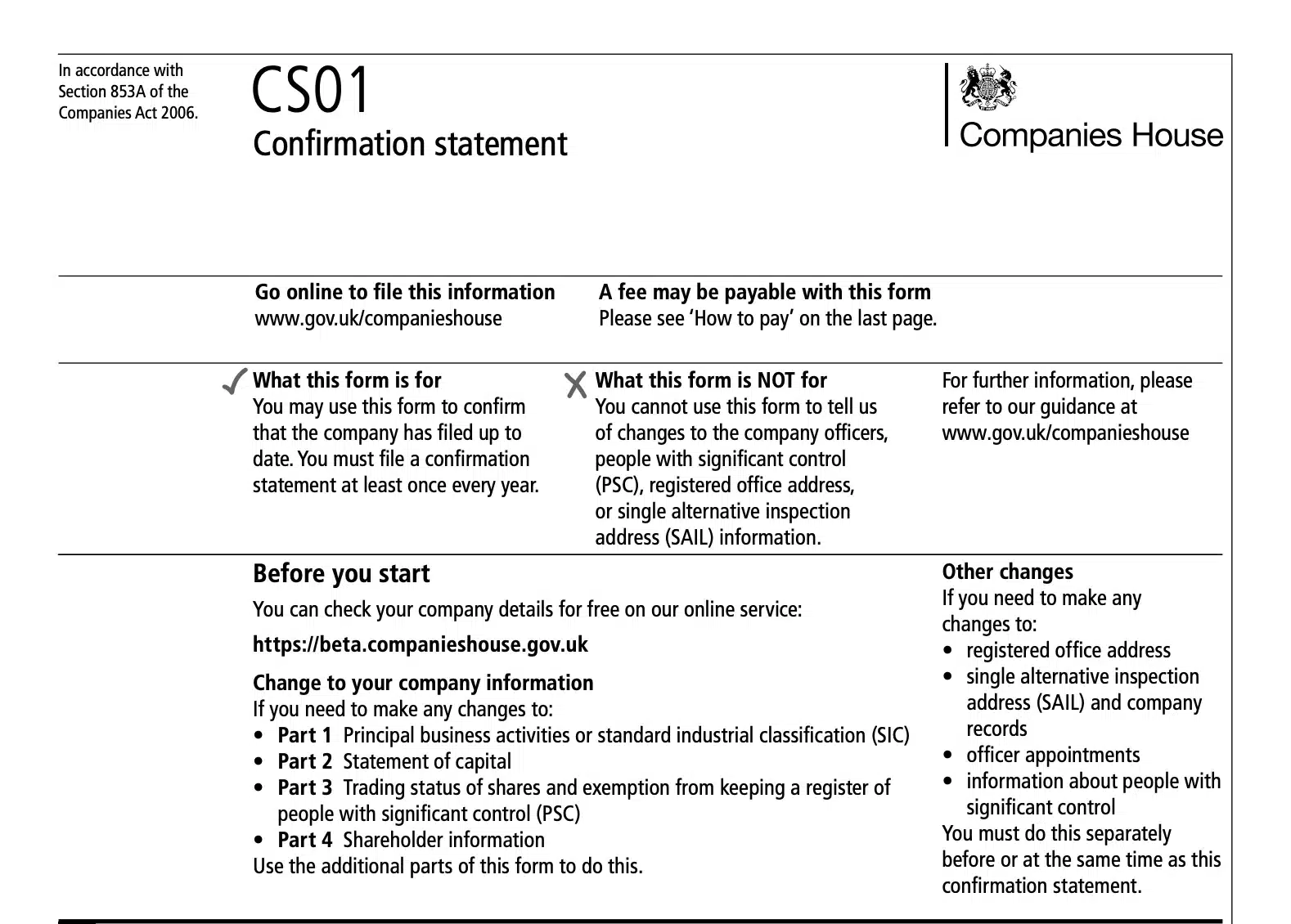
The process for filing a CS01 requires preparing company information, meeting new legal standards, and submitting the form to avoid penalties.
How to File Your Confirmation Statement in 3 Steps
-
Step 1: Review 6 Key Details and File Separate Update Forms First
You must first review Companies House search data on your company. Filing your confirmation statement legally confirms that every detail is accurate on the date you submit it.
Our company check tool shows what the register currently holds for your company, by name or number.
Review these 6 details before you file:
- Registered Office Address: Confirm the address is correct.
- Directors and Secretaries: Check that all current officers are listed and their details are accurate.
- People with Significant Control (PSC): Verify your PSC register is correct.
- Standard Industrial Classification (SIC) Codes: Ensure your SIC codes reflect your principal business activities.
- Statement of Capital: Confirm the details of your issued share capital.
- Shareholder Information: Check that the list of shareholders and their holdings is correct.
The CS01 form primarily confirms existing company information. You can update SIC code, statement of capital, trading status and shareholder information directly on the CS01 form: But, you must file the following company changes on separate forms before submitting your CS01:
- Appointing a director or secretary (Form AP01, AP03)
- Changing a director’s or secretary’s details (Form CH01, CH03)
- Terminating an officer’s appointment (Form TM01)
- Changing your registered office address (Form AD01)
- Updating your People with Significant Control (PSC) register (Forms PSC01, PSC07)
- Notifying an allotment of new shares (Form SH01)
Filing a CS01 with outdated officer or address details means you knowingly confirm incorrect information, which is an offence.
Step 2: Complete 3 Mandatory ECCTA Checks to Avoid Rejection
The Economic Crime and Corporate Transparency Act (ECCTA) introduced new obligations you must meet when you file a confirmation statement.
- Verify Director Identities: Every director must verify their identity with Companies House. The online system will block your CS01> submission until all directors complete this verification.
- Provide a Registered Email Address: You must provide a registered email address for your company the first time you file a CS01 after . Companies House uses this address for official communications but keeps it private.
- Declare a Lawful Purpose: You must confirm that your company’s intended future activities are lawful directly on the CS01 form.
-
Step 3: Choose Your Filing Method and Submit Within 14 Days
You must file your confirmation statement within 14 days of the end of your company’s “review period.” The review period for a new company is 12 months after its incorporation date. For existing UK companies, the review period is 12 months from the date of the last confirmation statement.
You have three options for completing and filing your CS01 with Companies House.
- Online via WebFiling: Filing online is the fastest method. You need your company’s 6-character authentication code to use the service, which pre-fills your information for review.
- Through an Agent: You can authorise an agent, such as Your Company Formations, to manage compliance and file the CS01 on your behalf.
- By Post: Submitting a paper CS01 form is the slowest option and has a higher risk of rejection due to errors.
You pay the filing fee once per 12-month period.
- Online Filing: £50
- Paper Filing: £110
Penalty: Late Filing is a Criminal Offence
Failing to file your confirmation statement on time is a criminal offence. It is not a civil matter, such as late company accounts.
The authorities can prosecute the company and its officers, including directors and secretaries. Conviction can lead to an unlimited fine and a criminal record for the individuals responsible.
Companies House will also begin the strike-off process for persistent failure to file. The strike-off process involves issuing warnings before Companies House publishes a notice in The Gazette to dissolve the company. If Companies House strikes off your company, banks will freeze its accounts, and its assets will pass to the Crown.
How the Rules Differ for LLPs, PLCs, and Other UK Companies
While the core duty to file an annual confirmation is universal, the specific form and information required can vary.
- Private Company Limited by Guarantee: Uses form CS01 but does not complete sections related to share capital or shareholders.
- Public Limited Company (PLC): Uses form CS01. If its shares trade on a regulated market, it is exempt from maintaining a PSC register and may only need to report shareholders who hold 5% or more of the shares.
- Limited Liability Partnership (LLP): Uses a different form, LL CS01. The LL CS01 form does not include sections on share capital or shareholders.
- Community Interest Company (CIC): Uses the standard CS01 based on its structure (limited by shares or guarantee). The CIC-specific annual report is a separate filing.
- Scottish Limited Partnership (SLP): Uses form SLP CS01, which requires PSC and SIC information but has no share capital sections.

Your email address will not be published. Required fields are marked *