
- Your employment status determines your income tax liability and national insurance contributions.
- An individual can be both employed and self employed if they work for an employer and run their business on the side.
What are the different types of employment status?
Employment status determines an individual’s legal rights and responsibilities at work. It is categorised based on type, employment rights, and criteria for determining status. The table below outlines the details of each type.
| Employment status | Definition | Rights & Limitations | Characteristics |
|---|---|---|---|
| Worker | Works under a verbal or written contract for money or benefits in kind (e.g., future work). |
Rights
Depending on the terms of engagement, they may be entitled to –
Limitations Workers are not entitled to –
|
|
| Employed | Works for an employer who sets working hours and deducts and reports Income Tax and NICs. |
|
|
| Self-Employed / Contractor | Runs their own business and is responsible for its success or failure. |
|
|
| Company Director | Manages limited companies on behalf of shareholders. |
|
|
| Office Holder | Appointed to a role by a company, often without a regular salary or service agreement. |
|
|
HMRC Tool: Check employment status for tax (CEST)
What is self-employment?
You will be treated as self-employed for tax purposes if you run your own business and are responsible for operations, income, and expenses. Unlike employees, self-employed individuals are not tied to a single employer and have greater autonomy over how, when, and where they work.
Examples of self-employed individuals include freelancers, sole traders and contractors.
See also: Self-Employed Class 2 National Insurance Contributions Explained
Can I be employed and self-employed at the same time?
For employment law purposes, you can be both employed and self-employed simultaneously. You can also choose to be solely employed, working for a company, or exclusively self-employed, working for yourself.
Here’s a breakdown of the key differences between being employed and self-employed:
| Difference | Employed | Self-Employed |
|---|---|---|
| Contract | Employment contract | Contract for service |
| Payment Frequency | Paid monthly or weekly based on terms of engagement. | Paid upon completion of tasks or milestones, as per contract terms. |
| Supervision | Supervised by an employer. | You supervise yourself. |
| Control over outcomes | Less control: work is directed by the employer with set tasks and responsibilities. | Greater control over how work is done and pricing; can choose clients and projects. |
| Responsibility for financial risk | Minimal financial risk; employer covers operational costs and provides tools. | Bears significant financial risk, including costs for tools, marketing, compensation in case of defective workmanship and overheads. |
| Income stability | Salary or wages are predictable according to the contracted payment cycle. | Income is unpredictable and dependent on the availability of contracts. |
| Tax responsibility | Taxes are calculated by the employer and paid at source through Pay As You Earn (PAYE Reference number). | The individual is responsible for calculating and paying taxes through self-assessment. |
| Liability for losses | Employees receive fixed salaries regardless of company performance. | Bears liability for losses and profits/income fluctuates depending on the performance of the business. |
| Place of work | Determined by the employer. You can only work from home, subject to the employer’s approval. | You decide where, when, and for whom you work. |
| Delegation and Exclusivity | You work exclusively for your employer unless your contract permits other work. You may have restrictions like non-compete clauses. | You can work for multiple clients and delegate tasks to others who share your skills. |
| Scope of work | Varies depending on the needs of the employer. | Defined by the terms of the contract, with any changes requiring review. |
| Benefits | Entitled to benefits like NICs, holiday pay, and sick leave. | Not entitled to benefits like holiday pay or sick leave. |
Being both employed and self-employed allows you the flexibility to explore different income streams and expand your skill set. Still, it’s essential to understand the responsibilities and legal obligations of each status.
Also related: Work From Home Tax Relief Clarified
Can I be working for someone but on a self-employed basis?
Yes, you can work for someone on a self-employed basis through a contract for service. This means you are providing services as an independent contractor rather than being employed by them. Operate in a service-based profession, such as accounting or consulting. You can offer your skills either as a sole trader, through a limited company, or as part of a Limited Liability Partnership (LLP).
Working this way gives you more control over how you manage your business, including when, where, and for whom you work. However, you are responsible for your taxes, insurance, and compliance with legal obligations.
Further reading: What Is a Limited Company and How to Register With Companies House
In what circumstances can an individual’s status be false self-employment?
False self-employment occurs when an individual is classified as self-employed, but their working conditions align more closely with those of an employee. Some employers often use this misclassification to bypass their obligations, such as paying employees tax and National Insurance contributions (NICs).
Signs that an individual is falsely classified as self-employed include:
- The individual works exclusively for one company.
- The company dictates work schedules, tasks, and how the work should be performed.
- The individual has limited autonomy over their work or business decisions.
If HMRC investigates and finds that the individual should be classified as an employee, the employer may be required to reclassify the worker correctly. This could result in the employer being held accountable for unpaid taxes and contributions. Sometimes, the employee may also need to address any discrepancies resulting from the misclassification.
If an individual is reclassified from self-employed to employee status, the employer may face substantial tax and NIC liabilities, potentially for past years. HMRC may allow offsetting of tax already paid by the individual against the employer’s new PAYE liabilities, but only in specific circumstances.
Since 6 April 2008, HMRC can issue a “direction”; allowing this offset, provided certain conditions are met, such as proper self-assessment by the individual. However, interest and penalties may still apply to the employer for any unpaid amounts. NIC contributions may also need adjustment, with HMRC often reallocating incorrectly paid Class 2 contributions as Class 1.
What employment rights do I have if I am employed or self-employed?
The main difference between being employed and self-employed lies in rights and responsibilities. Employees have statutory rights such as paid holidays, sick pay, maternity leave, and protection from unfair dismissal. Their employer handles tax deductions and provides a guaranteed income.
On the other hand, self-employed individuals run their businesses, controlling their work schedule and earnings but with no entitlement to paid leave or employer-provided benefits. They are responsible for managing taxes and have fewer legal protections, relying on contracts and health and safety laws for specific rights.
See also: Major UK Employment Law Changes Effective October 2024: What You Need to Know!
How does IR35 apply when working for one company?
Also known as off-payroll working, IR35 is an anti-tax avoidance measure introduced by HMRC to prevent companies from misclassifying individuals as contractors when they effectively function as employees. It primarily targets freelance contractors working through intermediaries, such as limited or personal service companies, especially those working for one client, who would otherwise be deemed employees if the intermediary didn’t exist.
If a contractor operates through an intermediary but meets the criteria of an employee, IR35 applies, and the contractor is taxed as if they are employed. However, IR35 rules exclude businesses classified as “small,” meaning these businesses are not required to assess or declare the employment status of contractors.
Find out more: Personal Service Company (PSC) & IR35 Explained!
If I work for an employer and am a self-employed contractor, what is the most tax-efficient way to pay myself?
If you are employed and work as a self-employed contractor, the best way to manage your earnings efficiently for tax purposes depends on how you set up your self-employment. Each business structure has different tax implications, including how income is taxed and reported.
If you operate as a sole trader, your self-employment income is taxed under Income Tax through Self Assessment. In addition, any salary you earn through your employer under PAYE must be declared as you complete a self assessment tax return. This ensures that HMRC has a complete picture of your total income, which helps calculate the correct tax and national insurance contributions.
For those who establish a Limited Liability Partnership (LLP), the tax treatment is similar to that of a sole trader. An LLP is treated as a “pass-through” entity, meaning the profits are taxed as personal income rather than at the partnership level. This makes the LLP tax-efficient for individuals who work collaboratively with others or use a dormant company as a partner.
Setting up a limited company offers additional options for tax efficiency. You can draw income as a salary, taxed under PAYE, or as dividends, subject to the dividend tax rate. Dividends often provide a more tax-efficient way to withdraw profits from your company, especially if your total income falls below higher tax thresholds. However, if you are an office holder without taking any salary or dividends, you may only need to pay tax if you receive other benefits or payments.
Find out more: 2024/2025 Tax Brackets UK: Income Tax Rates and Allowances
How do I pay taxes to HMRC if I am both employed and self employed?
If you are both employed and self-employed, your taxes are handled as follows:
- Employment income: Your employer deducts Income Tax and NI through PAYE.
- Self-employed income: You report your earnings through a Self Assessment tax return and pay any additional Income Tax and NI owed.
Declare your PAYE salary and self-employment income in your Self Assessment to give HMRC a full view of your taxable earnings.
Find out more: How to Register for Self Assessment Tax Return on GOV.UK
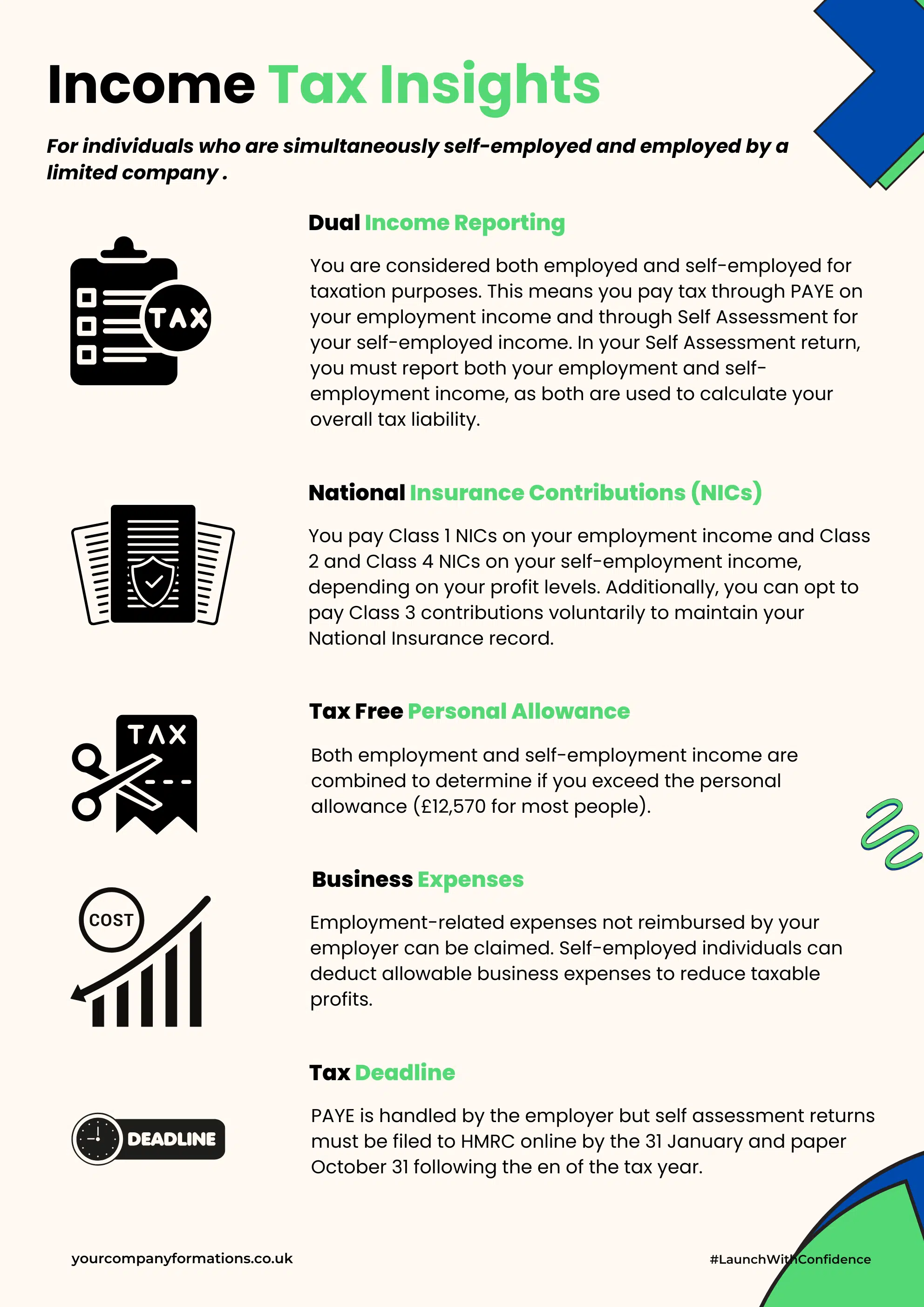
Infographic: Income Tax Insights

This is a great article and it was very informative and will prove to be helpful to Tax planning UK
Hi, I have quit my job to start my own business but get temp office work here and there unrelated to my business that would use my PAYE. so far not earned more than my personal allowance. What happens if I do not earn all my personal allowance in the year re tax on self employed/sole trader status?
Thanks
Hi,
I am currently working full time and am looking to set up my own business on the side.
I am also wanting to buy a house within the next year. Please can you advise if this will have an impact on me securing a mortgage despite me having a regular full time income as well as my own company on the side? As from previous answers this will therefore make me listed as ‘Sole Trader’.
How would I benefit from the income of my side hustle without being taxed eg through pay (as an employee) is the best way as the director of the company to take dividend shares when available instead?
Hi Callum,
To maximize the benefits from your side hustle, especially during the first year, it’s often a good idea to start as a sole trader, particularly if your income is below £20,000, since the first £12,570 of your earnings will be tax-free. As your income grows, transitioning to a private limited company might be more beneficial. In this case, the most tax-efficient way to withdraw profits would typically be through a combination of salary and dividends, with both being subject to different tax regimes.
It’s important to sit down with a qualified accountant to carefully plan when to make this shift, ensuring your decisions are based on solid figures and tailored to your specific situation.
For more information, read through the illustration provided in this article – https://www.yourcompanyformations.co.uk/blog/register-for-self-assessment/#How_do_I_calculate_my_self_assessment_tax_bill_based_on_the_income_and_deductions_reported
Hi, I currently earn £50,000 in my full time employment. I am looking to start up a business in my spare time doing the same job (my employers are aware of my part time work) but I have no clue where to even begin in terms of setting up a business, tax etc. Does a part time job effect my full time employment, in terms of tax, NI, pensions etc or is the part time job completely separate? I assume I need to declare my full time employment as part of my self-assessment but I’m just conscious I don’t want my part time work to affect my full time employment in any way. Does my tax code change for example? Are app based accountancy businesses a good way to manage my income, tax etc and preparing a self-assessment? I’ve read, as a sole trader I can be paid into my current account, is this correct? I won’t earn enough to warrant being VAT registered either, I envisage it may only be a few thousand pound per year I earn and I don’t intend on making this my full time employment at this stage. Also, what can be claimed as an expense through my part time employment? Any assistance would be greatly appreciated.
Hi Kevin
Congratulations on your decision to start a side business! I think It’s great that you’re exploring how to manage your new venture alongside your full-time employment. Let me walk you through some of your concerns.
Tax and National Insurance (NI):
Your part-time business and full-time employment are considered separate for tax purposes, but they do come together when calculating your overall tax liability. Your full-time employment income will continue to be taxed through PAYE, with your current tax code reflecting your personal allowance and any other deductions. When you start your part-time business, you’ll need to register as a sole trader with HMRC and complete a self-assessment tax return each year.
In your self-assessment, you’ll declare all your income, including your full-time employment earnings. HMRC will calculate your total tax liability based on your combined income, but your tax code for your employment shouldn’t change because of your side business. However, any additional tax due from your side business will be handled separately through your self-assessment.
Pensions:
Your part-time business won’t directly affect your workplace pension from your full-time job. Contributions to your workplace pension will continue as usual. If you wish, you can also explore setting up a separate personal pension for your part-time income.
Expenses:
As a sole trader, you can claim various business-related expenses to reduce your taxable income. These might include costs related to your work, such as office supplies, software subscriptions, travel expenses, and even a portion of your home utility bills if you work from home. It’s important to keep detailed records of your expenses, as these will be essential when completing your tax return.
App-Based Accountancy Services:
App-based accountancy services can be a convenient and cost-effective way to manage your business finances, especially if you anticipate your side business earnings to be relatively modest. These services often offer features like automatic expense tracking, invoice management, and tax calculation, which can simplify the self-assessment process.
Bank Account:
You can receive payments for your side business into your personal bank account if you are a sole trader. However, many people find it helpful to set up a separate account to keep their personal and business finances distinct, making it easier to track income and expenses.
VAT Registration:
Since you expect your earnings to be below the VAT threshold, you won’t need to register for VAT at this stage. You can always register later if your business grows and your turnover exceeds the threshold.
Starting a side business is an exciting step, and with careful planning, you can manage it alongside your full-time job without any issues.
I hope this helps, and I’m happy to assist with any further questions you may have!
Oh my gosh, you have answered most, if not all the questions i have been asking myself.
This is what I have understood.
So – do have to register as Sole trader with HMRC so that one can do Self Assessment – though this can be done up to three months after taking an initial income in second job.
No need to be VAT reg, as second job earning would be below the threshold (as main job and second job are considered separate entities for taxation purposes).
Ok, so as opposed to taking a wage from the second job – i heard something about paying oneself dividends monthly, as opposed to a wage.. is that a thing? pros and cons?
I just read your reply to Chris about some trader income. So, If I use my full personal tax allowance in my primary job, am I still entitled to the sole trader allowance for my secondary job? You mentioned that it wasn’t included in PAYE but wanted to make sure. Thanks
Hi Sharon,
No, the personal allowance cannot be applied to your sole trader income if it is already used up under PAYE for your employment income.
A really good, and useful read. Can I ask, if I earn over £55k from an employed role, what tax will I pay on my sole trader income? Do I need to register etc?
Great question! Since your sole trader income isn’t taxed under PAYE, you’ll need to register for self-assessment. For the current tax year (2024/25), here’s how your profits will be taxed:
– You will pay income tax and Class 1 NI contributions through PAYE on your employment income.
– You cannot apply your personal allowance to your sole trader income, as it is already used for your employment income.
– Your sole trader income will be taxed at the higher rate of 40%.
– You will need to pay Class 4 contributions.
– Class 2 NICs have been abolished for self-employed individuals from April 6, 2024.
Let us know if you have any more questions!